Intuition
Now sweep the bias through an avoided crossing at a steady rate. A slow sweep follows the adiabatic level and ends in the other diabatic state; a fast one does not notice the coupling and stays in the diabatic state it started in, jumping the gap. Landau and Zener found the exact probability of the jump: , where is the smallest gap and the rate at which the bias changes. It depends on one number, the square of the gap over the sweep rate. It is exact, and it comes from summing the whole Dyson series of the problem.
A car taking a bend in the road: slowly, it follows the bend; fast, it goes straight on. How fast is too fast depends on how sharp the bend is — for an avoided crossing, on the square of the smallest gap.
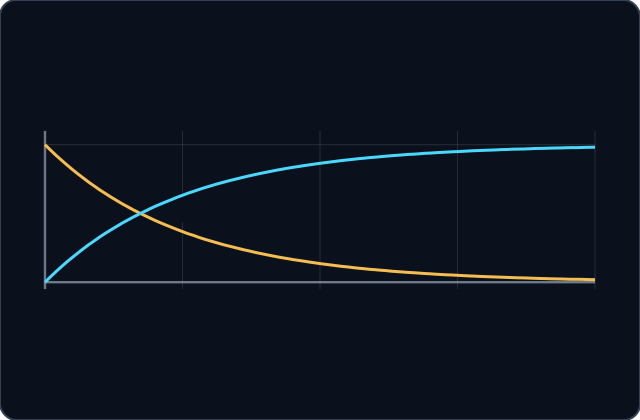
The probabilities of jumping the gap, , and of following the adiabatic level, , against . Fast sweeps, small , jump; slow sweeps, large , follow.
The Landau–Zener formula
For , swept from to with the system starting in a diabatic state:
Properties
- is the probability of ending in the same diabatic state, crossing the gap; is the probability of following the adiabatic level.
The Landau–Zener formula through the Dyson series
Remove the diagonal by a change of phase, which leaves a Hamiltonian with only off-diagonal entries that turn in time. Its odd powers are off-diagonal and its even powers diagonal, so in the Dyson series only even orders keep the system in its first state. The -th order is times a nested integral equal to , shown here for and stated beyond it, and the series sums to an exponential.
Proof steps
The change of phase on the two components removes the diagonal.
Odd powers of an off-diagonal matrix are off-diagonal: only even orders of the Dyson series keep .
For , with times in units of , the ordered integral is half of , the two orderings being equal by symmetry; the general case is stated here.
The exponential series.
Square the modulus.
Applications
Practice
The Formula
A linear sweep through an avoided crossing jumps the gap with probability , where .
Try it
A sweep has . What is the probability of jumping the gap? Give three decimal places.
Slow and Fast
A slow sweep follows the adiabatic level and ends in the other diabatic state; a fast sweep stays in the diabatic state it started in.
Try it
A sweep through an avoided crossing is made much slower. What happens?
Gap Squared Over Rate
The probability depends on the sweep only through : doubling the gap has the effect of slowing the sweep fourfold.
Try it
Doubling the smallest gap has the same effect on the jump probability as sweeping four times more slowly.
Faster Sweeps Jump
Doubling the sweep rate halves , and the jump probability rises.
Try it
A sweep with is made twice as fast. What is the jump probability now? Give three decimal places.
Try it
The same sweep is often written . How are its and related to and here?
Try it
For a fast sweep with , first-order perturbation theory gives the probability of following the adiabatic level as . What is the exact value? Give three decimal places.
Try it
First-order perturbation theory gives the Landau–Zener probability exactly.
Final checkpoint
Try it
In the exact derivation, why do only even orders of the Dyson series contribute to staying in the first state?
Try it
An infinitely fast sweep leaves the system in the diabatic state it started in.
Try it
On what does the Landau–Zener probability depend?
Completion
Lesson complete
Great work! You now know how to:
- state the Landau–Zener formula and its one parameter
- follow the exact derivation through the Dyson series
- tell slow sweeps from fast ones