Intuition
A slow sweep through an avoided crossing moves a system from one diabatic state to the other with near certainty, and it does not care about the details: the exact rate, the exact coupling, the shape of the pulse, as long as the adiabatic theorem holds. That robustness is why adiabatic passage is used where a pulse, which needs its length and strength just right, would be fragile. A fast sweep, by contrast, leaves the state behind — the diabatic limit, the sudden approximation of the chapter on time-dependent perturbations. Between them the Landau–Zener formula interpolates, and a sweep can be tuned to split a state into any chosen superposition.
Carrying a full glass across a moving train: walk steadily and the water stays in the glass, however the train sways; lurch and it spills. The steady walk is adiabatic passage — forgiving of every detail, as long as it is slow.
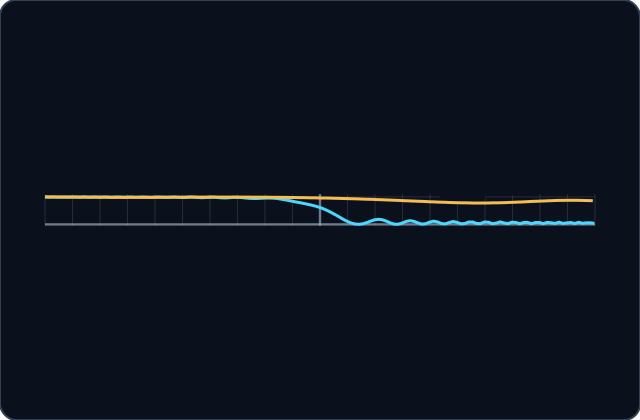
The probability of the starting diabatic state against the bias , computed exactly for two linear sweeps from to . The slow one () moves the system into , leaving behind. The fast one () leaves most of it in : about 0.86 at the edge of the picture, where it still rings, settling to as the sweep goes on.
Adiabatic and diabatic evolution
A system starting in the ground state far to one side of an avoided crossing, swept to the far side:
Properties
- Slow sweep, adiabatic: the state follows , which turns from into : complete transfer.
A slow sweep transfers the state
Far to the left the ground state is . By the adiabatic theorem a slow sweep keeps the system in the ground state of each moment, which is . The mixing angle turns from to as the bias goes from left to right, which carries from to .
Proof steps
Far to the left, and the ground state is up to a sign.
The adiabatic theorem, with the gap never smaller than .
The ground state at mixing angle .
Far to the right the ground state is .
For a finite rate, the Landau–Zener formula gives the shortfall.
Applications
Practice
Transfer by Following
Following the ground state through an avoided crossing moves the system from one diabatic state to the other. The part left behind is the Landau–Zener jump probability.
Try it
A sweep has . What is the probability of ending in ? Give two decimal places.
Robustness
Adiabatic passage does not need the rate or coupling to be exact: any slow enough sweep transfers the state. A pulse needs its length and strength just right.
Try it
Why is adiabatic passage preferred to a pulse when the drive strength varies across a sample?
The Diabatic Limit
A sweep much faster than the gap allows leaves the state as it was: the sudden limit of the chapter on time-dependent perturbations.
Try it
A very fast sweep through an avoided crossing transfers the system to the other diabatic state.
Splitting on Purpose
At an intermediate rate the sweep leaves a chosen share in each state: the Landau–Zener formula tells which rate gives which share.
Try it
What value of leaves equal probabilities in and ? Give three decimal places.
Try it
In a slow sweep, which state does the system stay in throughout?
Try it
A sweep with is made three times faster. What is the probability of ending in now? Give three decimal places.
Try it
Adiabatic methods can move population between two levels through a third level that is never occupied.
Final checkpoint
Try it
In quantum annealing, what decides how slowly the Hamiltonian must be changed?
Try it
A pulse with its area 10 per cent too large still transfers the whole population.
Try it
What formula describes sweeps between the slow and the fast limits?
Completion
Lesson complete
Great work! You now know how to:
- explain why a slow sweep transfers the state
- compute the transfer for a finite rate
- compare adiabatic passage with a pulse