Intuition
The ladder argument decides the whole spectrum from the commutators alone. can only take the values , and for each the component takes the values with running from to in steps of one. Since the top is reached from the bottom in whole steps, is a whole number: is a whole number or a half-integer. The half-integers are not a curiosity — they are the spin of the electron.
A vector of fixed length that may only point at a few heights above the floor looks like a cone of possible directions around the vertical, with rungs where its tip may sit. That cone is the usual picture of quantum angular momentum.
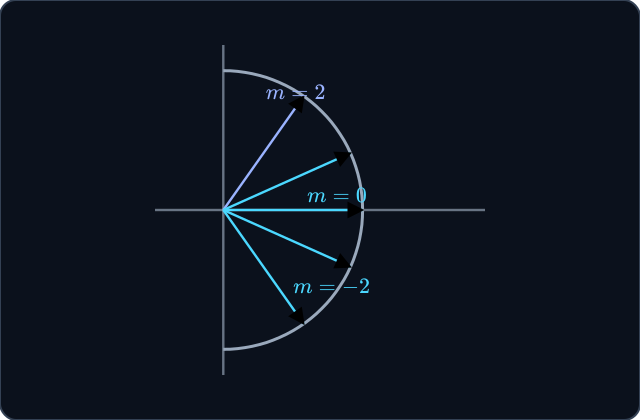
The five states of in the usual picture: a vector of length in units of , the vertical axis being , whose height can only be . It never points straight up: even for the length exceeds the height, because and are never both zero.
The eigenvalues of \hat{J}^{2} and of its z component
The simultaneous eigenstates of and are labelled by and . The commutation relations alone fix the possible values.
Properties
- For each there are values of : 1 for , 2 for , 3 for , 4 for .
The spectrum of angular momentum
At fixed the eigenvalue of is bounded, so raising must stop at a top rung and lowering at a bottom one. Applying to those rungs, written through and , fixes the top at and the bottom at , and whole steps from one to the other make a whole number.
Proof steps
Squares of Hermitian operators have non-negative averages, so is bounded.
On the top rung the first term gives zero.
Name the top value .
Use on the bottom rung; the other root, , lies above the top.
The bottom is reached from the top in whole steps of one.
Applications
Practice
2j+1 States
For a given , the component takes the values from to in steps of one, in units of .
Try it
How many states does have?
The Length
takes the value — not .
Try it
What is the eigenvalue of for , in units of ?
Whole or Half
Because the top of the ladder is reached from the bottom in whole steps, is a whole number: is a whole number or a half-integer.
Try it
Which value is not allowed for ?
One Kind at a Time
The values of for one differ by whole numbers, so they are all whole numbers or all half-integers.
Try it
One value of can have both and among its states.
Try it
For , , what angle does the vector of the usual picture make with the axis, in degrees?
Try it
In the state , what is in units of ?
Try it
In the state the angular momentum points exactly along the axis.
Final checkpoint
Try it
A state has . What is the largest possible value of , in units of ?
Try it
Which step of the ladder argument allows half-integer values of ?
Try it
In the state , what is in units of ? Give three decimal places.
Completion
Lesson complete
Great work! You now know how to:
- derive the eigenvalues of and from the commutators