Intuition
The joint eigenfunctions of and are functions of direction alone, the spherical harmonics . Their dependence is ; their dependence is a polynomial in and . The top one of each ladder is simply , and lowering it gives the rest. Their shapes — a sphere for , two lobes for , lobes and a ring for — are the shapes chemists draw for s, p and d orbitals.
A globe can be coloured by latitude and longitude in patterns with a few bands and a few meridians; the spherical harmonics are the patterns with the fewest bands and meridians for each amount of wiggling, and every colouring of the globe is a sum of them.
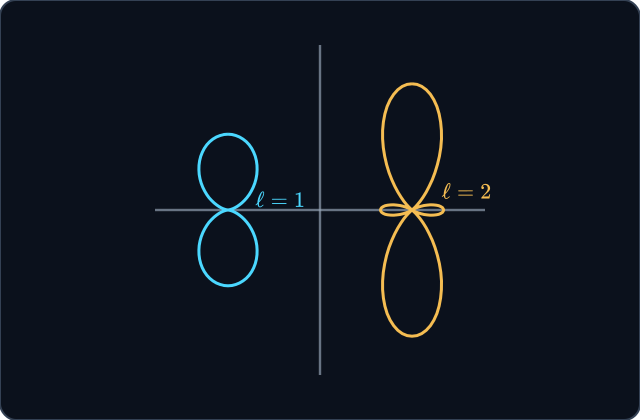
Polar plots of and in a plane containing the axis, which points up: the distance from each centre in a direction is the probability density in that direction. has two lobes along ; has two lobes and a ring round the middle, separated by cones where it vanishes.
Spherical harmonics
is the normalised joint eigenfunction of and . It is orthonormal over the sphere, and every function of direction is a series in them.
Properties
- Orthonormality on the sphere: with .
The top of each ladder
The top state has , so its dependence is , and raising it gives zero. With the raising operator in spherical coordinates, that condition is a first-order equation for the part, solved by a power of .
Proof steps
The raising operator in spherical coordinates, quoted without its derivation.
An eigenfunction of with .
The derivative brings down , and .
Separate and integrate, since .
Lowering times gives every other harmonic of the ladder.
Applications
Practice
The Constant Harmonic
For the harmonic is a constant, the same in every direction. Normalising it over the whole sphere, of solid angle , gives .
Try it
What is ? Give three decimal places.
The Top Harmonic
The harmonic at the top of each ladder is , up to a constant.
Try it
Which function is proportional to ?
Even and Odd
Reflecting through the origin multiplies a spherical harmonic by .
Try it
Every is odd under reflection through the origin.
Integrating Over the Sphere
Integrals over directions use the solid-angle element , with from 0 to and from 0 to .
Try it
What is ? Give three decimal places.
Try it
At what angle from the axis, in degrees, does first vanish? Give one decimal place.
Try it
How does depend on ?
Try it
.
Final checkpoint
Try it
What is on the positive axis? Give three decimal places.
Try it
What is ?
Try it
Every reasonable function of direction on the sphere can be written as a series of spherical harmonics.
Completion
Lesson complete
Great work! You now know how to:
- write the first spherical harmonics and normalise them
- derive the top harmonic of each ladder
- read the shapes, nodes and parities of the harmonics