Intuition
Combine the two components that are not measured into and . Their commutators with make them step its eigenvalue up and down by exactly , while leaving alone. So the states of given form a ladder of values one apart, and the ladder must stop at both ends, because a component cannot exceed the length of the vector.
On a dial with fixed length, the needle can point at different heights but can never point higher than its own length. The ladder operators move the height by one notch; the ends of the dial stop them.
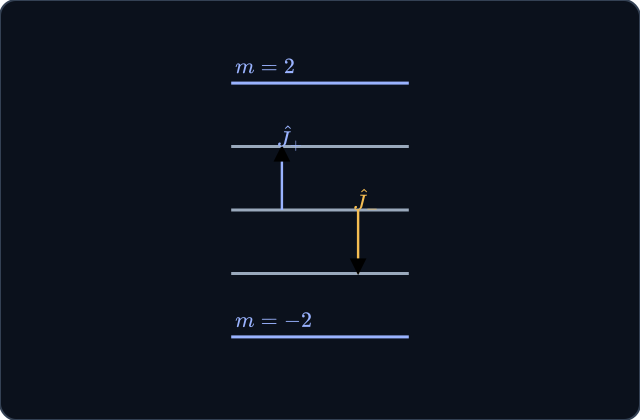
The five states of , one for each from to , in units of . moves a state one rung up, one rung down, and is the same on every rung. On the top rung gives zero; on the bottom one does.
Raising and lowering the z component
are adjoints of each other. They commute with and step the eigenvalue of by .
Properties
- If , then : raising adds to , unless it gives zero.
The raising operator steps m up by one
Compute the commutator from the cyclic relations, then move past in : it picks up the commutator, which adds or removes one .
Proof steps
The commutator is linear.
The cyclic relations.
Take out .
Move to the right, using the commutator.
Applications
Practice
One Rung
The raising operator adds to the component; the lowering operator removes one. The total is untouched.
Try it
A state has . What is , in units of , for , if it is not zero?
Adjoints of Each Other
The raising and lowering operators are each other’s adjoints, since and are Hermitian.
Try it
What is ?
Same Length on Every Rung
The ladder operators commute with : every state of a ladder has the same total angular momentum.
Try it
Applying to a state changes its eigenvalue of .
Their Commutator
The commutator of the raising and lowering operators is .
Try it
A state has . What is , in units of ?
Try it
Which combination of ladder operators is ?
Try it
A state has . After is applied four times, what is in units of , if the result is not zero?
Try it
.
Final checkpoint
Try it
Why must the ladder of values stop at the top?
Try it
. What is ?
Try it
is an observable.
Completion
Lesson complete
Great work! You now know how to:
- define the raising and lowering operators of angular momentum
- prove that they step by one unit of
- rewrite through and