Intuition
Classically, angular momentum is : a vector at right angles to the plane of the motion, as long as the distance times the momentum across it. In quantum mechanics its three components become operators, each the generator of rotations about its axis. They are observables, but not compatible ones: no state has a definite value of all three unless all three are zero. What can be known together is the total, , and one component, by convention .
A spinning top has an axis you can point to. A quantum top has a definite length of angular momentum and a definite projection on one axis, but the rest of its direction is as uncertain as a position and a momentum are.
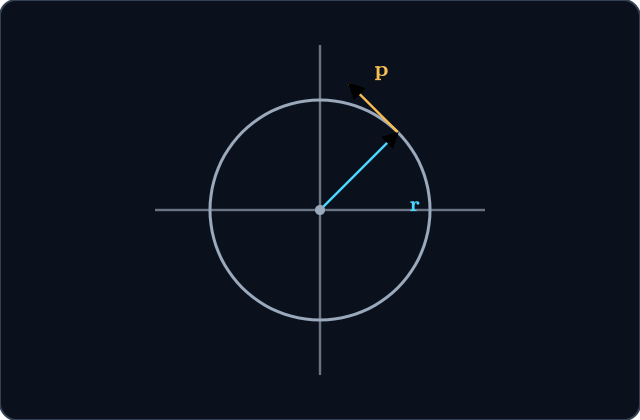
A particle going round a circle. Its angular momentum points out of the page and has size . In quantum mechanics its three components become operators, and they cannot all be known at once.
The angular momentum operators
Replace and in by operators. Each component is Hermitian, and the square of the whole vector is a fourth observable.
Properties
- Each factor in a product such as belongs to a different direction, so the factors commute and the order does not matter.
- , and generate rotations about their axes, as the symmetry chapter found for .
The components are Hermitian
The adjoint of a product reverses its order. In each product joins a coordinate to a momentum in another direction, which commute, so reversing the order changes nothing.
Proof steps
The component of .
The adjoint reverses products, and positions and momenta are Hermitian.
A coordinate commutes with the momentum along a different axis.
Swap each pair back; the same holds for the other two components.
Applications
Practice
What Can Be Known Together
The components of angular momentum do not commute with one another, but each commutes with . So the length of the angular momentum and one component can be known together; two components cannot.
Try it
Which pair of observables can have definite values in the same state?
Order Does Not Matter Here
In each coordinate is multiplied by a momentum along another axis. Those commute, so the products need no ordering rule, and each component is Hermitian.
Try it
.
The Classical Picture
For a particle going round a circle of radius with momentum along the circle, the angular momentum points along the axis and has size .
Try it
A particle at has momentum . What is ?
One Component at a Time
The convention is to choose and as the observables with definite values. Nothing is special about : any direction could be chosen instead.
Try it
Why are atomic states usually labelled by and rather than and ?
Try it
A classical particle has . What is ?
Try it
A state with a definite nonzero value of all three components of angular momentum exists.
Try it
A particle at has . What is ?
Final checkpoint
Try it
Why is Hermitian although is not?
Try it
J s. A molecule has angular momentum . What is it in units of J s? Give three decimal places.
Try it
commutes with , with and with .
Completion
Lesson complete
Great work! You now know how to:
- write the components of angular momentum as operators
- show that they are Hermitian
- say which angular momentum observables can be known together