Intuition
Rotate a state of definite and it stays within the same : rotations commute with , so they only reshuffle the states of one ladder among themselves. The reshuffling is a unitary matrix, the rotation matrix. About the axis it is diagonal — each state just acquires a phase . About another axis it mixes the values, with probabilities that are fixed functions of the angle. And for half-integer a whole turn gives , a sign no ordinary object shows.
Turning a box of coloured beads changes which colour faces up, but never the number or kind of beads in the box. A rotation changes the mixture of values but never .
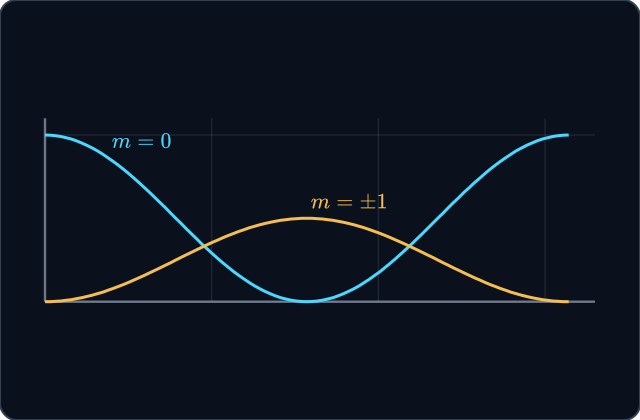
A state rotated by an angle about the axis, from 0 to : the probability of still finding is , and of finding or is each. The three always add to one, and at the state is back to .
Rotation matrices
A rotation maps into combinations of the states of the same . The coefficients form a unitary matrix .
Properties
- About the axis the matrix is diagonal: .
A rotation keeps j
commutes with every component, so with every function of them, including any rotation. A rotated eigenstate of is therefore an eigenstate with the same eigenvalue, which is a combination of the states of that .
Proof steps
From the lesson on commutators.
A power series in the components.
Every term commutes with .
The rotated state has the same eigenvalue of .
Expand it in the states of that ; the coefficients are the rotation matrix.
Applications
Practice
Rotations Keep j
A rotation commutes with , so it maps the states of one among themselves. Only the mixture of values changes.
Try it
A state is rotated about the axis. What can the rotated state contain?
About the z Axis
Rotating about the axis only multiplies each by the phase .
Try it
is rotated by about the axis. What is the real part of the phase it acquires?
A Full Turn
For half-integer , a rotation by a full turn multiplies every state by . Two full turns are needed to come back exactly.
Try it
For , a rotation by about any axis is the identity.
Mixing Probabilities
Rotating by about the axis leaves with probability and gives with probability each.
Try it
is rotated by about the axis. What is the probability of still finding ? Give two decimal places.
Try it
For the same rotation of by , what is the probability of finding ? Give three decimal places.
Try it
What is at ?
Try it
The probabilities for a fixed add to one over all .
Final checkpoint
Try it
A state with , is rotated by about the axis. What is the real part of the factor it acquires?
Try it
Why does a rotation never change ?
Try it
is rotated by about the axis. What is the imaginary part of the phase factor it acquires?
Completion
Lesson complete
Great work! You now know how to:
- explain why rotations keep and mix
- use rotation matrices about the and axes
- show that half-integer states change sign under a full turn