Intuition
Which totals can two angular momenta and make? Every value from the difference to the sum , in whole steps, each exactly once. Counting states settles it. The total projection runs from to , and the number of product states at each grows by one per step down from the top until it levels off. Each multiplet puts one state at every from to , so a new multiplet must begin wherever the count grows. The classical picture agrees: the length of the sum of two vectors lies between the difference and the sum of their lengths.
Two sticks of lengths 2 and 1, joined by a hinge, can put their far end anywhere from 1 to 3 from the start. Quantum angular momenta do the same, but only in whole steps: , 2 or 3.
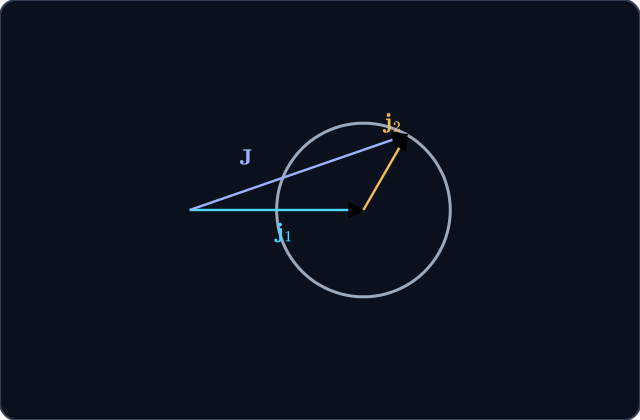
The classical picture of adding and : the tip of can lie anywhere on the dashed circle, so the length of runs from to . Quantum mechanics keeps the range and allows only .
The addition rule
Two angular momenta and combine into the totals, in whole steps:
Properties
- Each allowed appears exactly once, with its states , .
The possible totals
Take and count the product states at each value of . Each multiplet contributes exactly one state to every it covers, so the number of multiplets with is the number of states at minus the number at . That difference is 1 from the top down to , and 0 below it.
Proof steps
The projections add.
Count the pairs on the line ; for the count stays at .
move through its states one step at a time.
The multiplets with already fill of the states at ; below the difference is 0.
One multiplet for each of these values, and no others.
Applications
Practice
The Rule
Two angular momenta combine into every total from the difference to the sum of their quantum numbers, in whole steps.
Try it
Which totals can and make?
The Count Agrees
Adding up over the allowed totals gives the number of product states, : no state is lost or made.
Try it
For and , what is the sum of over the allowed ?
Integers and Half-Integers
moves in whole steps from . Two half-integers therefore add to integer totals, and an integer with a half-integer to half-integer ones.
Try it
Two half-integer angular momenta can add to a half-integer total.
The Triangle Rule
The total and the two parts must be able to form a triangle: the total is at least the difference and at most the sum.
Try it
Can and combine to ?
Try it
What is the smallest total that and can make?
Try it
When two angular momenta are added, each allowed value of appears exactly once.
Try it
How many different totals do and make?
Final checkpoint
Try it
An electron with has spin . Which totals can it have?
Try it
For and , more product states have than have .
Try it
Why does each total appear only once when two angular momenta are added?
Completion
Lesson complete
Great work! You now know how to:
- find every total two angular momenta can make
- derive the addition rule by counting states
- check the rule against the dimension of the product space