Intuition
An electron moving through the electric field of a nucleus sees, in its own rest frame, a magnetic field, and its magnetic moment feels it: an energy proportional to . This spin–orbit interaction does not commute with or , since it turns orbit and spin into each other, but it commutes with , and the total . So its eigenstates are the coupled states, and a level with splits in two, and . The yellow light of sodium is split this way into two lines 0.6 nm apart.
A spinning top carried round a circle on a turntable trades angular momentum with the turntable through friction: neither keeps its own, only the total is fixed. Spin and orbit trade the same way under spin–orbit coupling, and only the total keeps its value.
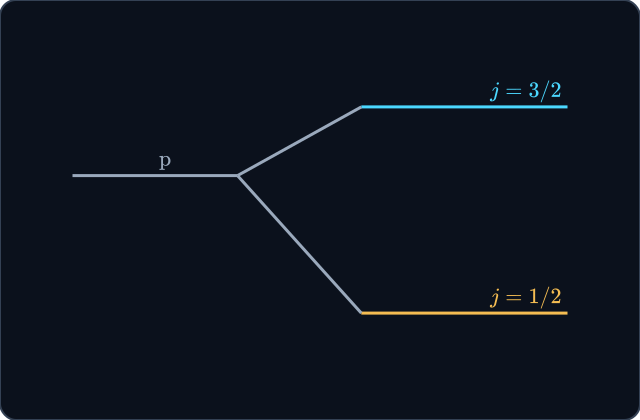
A level of one electron, six states, split by with , in units of : four states with rise by and two with fall by , so the centre, weighted by the number of states, stays put.
Spin–orbit coupling
For an electron in a central potential the spin–orbit interaction is
Properties
- The form of comes from relativity; it is derived from the Dirac equation in the chapter on relativistic quantum mechanics and taken here as given.
- commutes with , , and but not with or : the good quantum numbers are , , and .
The spin–orbit energies
Square the total angular momentum. Because and act on different parts they commute, and the cross term is twice their dot product. Solving for the dot product writes it through three squares, all diagonal in the coupled basis; putting in gives the two shifts.
Proof steps
and commute, so the two cross terms are equal.
Solve for the dot product.
All three squares are diagonal in the coupled basis, with .
.
.
Applications
Practice
The Dot Product in the Coupled Basis
In the coupled basis the dot product of orbit and spin is half the difference of three squares, each a number.
Try it
What is for a electron with , in units of ?
What Is Conserved
Spin–orbit coupling turns orbital angular momentum into spin and back. The separate -components are no longer fixed, but the magnitudes and the total are.
Try it
Which quantum numbers stay good when spin–orbit coupling is included?
No Splitting for s
With the only total is , and the dot product of orbit and spin is zero: s levels are not split by spin–orbit coupling.
Try it
An level is split in two by spin–orbit coupling.
Which Way the Levels Move
For the level with rises by and the level with falls by .
Try it
With , which level of a electron lies higher?
Try it
Sodium’s two lines are at nm and nm. With eV nm, what is the energy between the two upper levels, in meV? Give one decimal place.
Try it
Weighted by the number of states, the average spin–orbit shift of a level with is zero.
Try it
For a electron, , what is the size of the shift divided by the size of the shift? Give two decimal places.
Final checkpoint
Try it
A level of one electron has six states. How are they shared between the two levels spin–orbit coupling makes?
Try it
Spin–orbit coupling conserves .
Try it
Landé’s interval rule says the gap between the levels and of a multiplet split by is proportional to what?
Completion
Lesson complete
Great work! You now know how to:
- write the spin–orbit interaction through the total angular momentum
- compute its energies for
- say which quantum numbers stay good and why s levels are not split