Intuition
The numbers that write each coupled state in the product basis are the Clebsch–Gordan coefficients. They are found the way the triplet was: start at the top state, the one product with the largest ; lower it with the total lowering operator to fill the multiplet of the largest ; at the next value of the state orthogonal to what has been built is the top of the next multiplet; and so on down. With the standard choice of phases they are real numbers. They vanish unless and the triangle rule holds, and their squares are probabilities: the chance of finding each pair in a state of definite .
Converting a recipe from cups to grams uses a fixed table: each amount in the new units is a set mixture of the old. Clebsch–Gordan coefficients are the conversion table between the uncoupled and the coupled bases, worked out once and used forever.
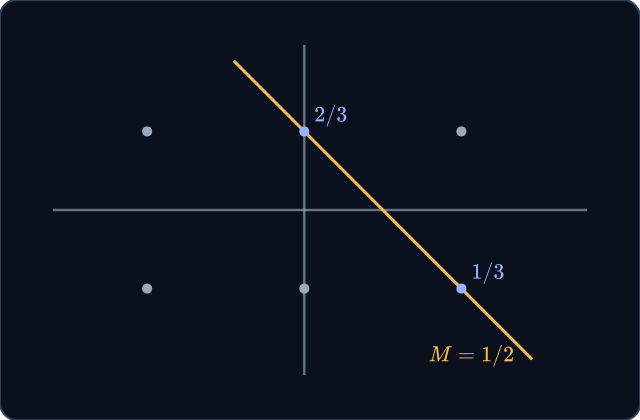
The six product states of and at . The coupled state lies on the line and is made of its two products, found with probabilities and , the squares of its Clebsch–Gordan coefficients.
Clebsch–Gordan coefficients
The coupled states in terms of the uncoupled ones:
Properties
- unless and .
Coupling 1 and \tfrac12
Start from the top product, which is . Lower it in two ways: with the total lowering operator acting on the coupled state, and with the sum of the parts’ lowering operators acting on the product. Equating the two gives the next state of the multiplet; the combination orthogonal to it is the top of .
Proof steps
The only product with .
.
Each part lowers its own factor.
Equate the two and divide by .
Orthogonal to the last state, with the coefficient of positive by convention.
Applications
Practice
Squares Are Probabilities
Each Clebsch–Gordan coefficient is the amplitude for one pair in a coupled state, so its square is the probability of finding that pair.
Try it
In the state of , what is the probability of finding the spin up? Give three decimal places.
When They Vanish
A Clebsch–Gordan coefficient is zero unless the two projections add up to and the totals satisfy the triangle rule.
Try it
Which Clebsch–Gordan coefficient must vanish?
A Phase Convention
Each multiplet may be multiplied by a phase. The Condon–Shortley convention fixes it by making one coefficient of each multiplet positive; lowering then produces only real numbers.
Try it
With the standard phase convention, every Clebsch–Gordan coefficient is a real number.
Normalised Combinations
The coefficients of one coupled state are the components of a unit vector, so their squares add up to one.
Try it
A coupled state is a combination of two products. One Clebsch–Gordan coefficient is 0.6 and the other is positive. What is the other?
Try it
How is the multiplet built in the product basis?
Try it
What is ?
Try it
of can be taken as .
Final checkpoint
Try it
At there are two product states. What is the combination orthogonal to ?
Try it
The state of is a single product state.
Try it
In , what is the probability of finding the spin up? Give three decimal places.
Completion
Lesson complete
Great work! You now know how to:
- build coupled states from the top state by lowering
- read Clebsch–Gordan coefficients as amplitudes and their squares as probabilities
- use the rules that make them vanish