Intuition
Light drives an atom from one level to another through the electric dipole operator : a jump from to goes at a rate proportional to . Most of these matrix elements vanish for reasons of symmetry alone. Parity: is odd, so the two levels must have opposite parity. Angular momentum: is a vector, which carries one unit, so can change by at most one — and with parity, by exactly one — while changes by 0 or . These are the dipole selection rules. In hydrogen is allowed and is forbidden, and 2s lives about a hundred million times longer as a result.
A key opens only locks cut to its shape. The dipole operator carries exactly one unit of angular momentum and odd parity, and it can join only levels whose angular momenta and parities differ in just that way.
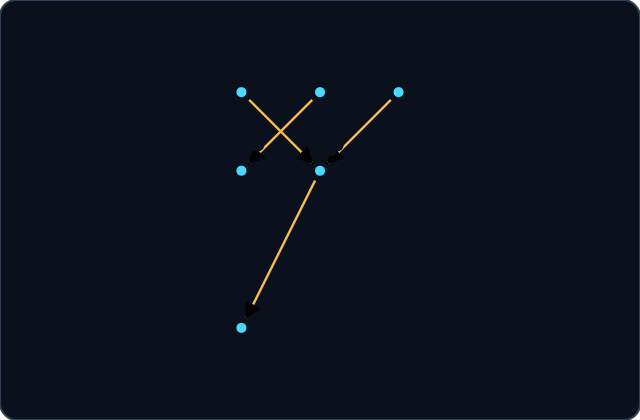
The lowest levels of hydrogen, set in columns by with the energies not to scale, and the dipole jumps between them: every arrow changes by one. There is no arrow from 2s, which can reach 1s only by far slower processes.
Dipole selection rules
Between states of a central potential, the dipole matrix element vanishes unless
Properties
- The rate of a jump driven by light is proportional to , with the polarisation; this lesson asks only when that element can be nonzero.
The dipole selection rules
Use commutators with to find which changes of each component allows, parity to rule out an even change of , and the addition rule, applied to the angular parts of the functions, to rule out a change of by more than one.
Proof steps
Sandwich the commutator between the two states.
The same, for the components that raise and lower .
is odd and the states have parities and .
The angles of are a set; by the addition rule, applied to angular functions as to states, and make only these.
Parity removes , leaving a change of exactly one.
Applications
Practice
The Rules
A dipole jump changes by exactly one and by at most one.
Try it
Which jump in hydrogen do the dipole selection rules allow?
Parity
The dipole operator is odd under inversion. Its matrix element between two states of the same parity is the integral of an odd function, which is zero.
Try it
A dipole jump can join two levels of the same parity.
m Changes by at Most One
The component raises by one, lowers it by one, and leaves it alone.
Try it
The operator acts on a state with . What must the final state have for a nonzero matrix element?
Light Polarised Along z
Light polarised along couples through the component of , which commutes with .
Try it
Light polarised along drives jumps through . Which change of does it allow?
Try it
Hydrogen’s 2s level lives about s and its 2p level ns. By what factor does 2s outlive 2p, in units of ? Give one decimal place.
Try it
A jump forbidden by the dipole selection rules can still happen, far more slowly, by other processes.
Try it
To which lower levels can hydrogen’s 3d level jump by a dipole transition?
Final checkpoint
Try it
The allowed jump in hydrogen emits a photon of what energy, in eV? Use eV.
Try it
A dipole jump from to is allowed when the two levels have opposite parities.
Try it
Why can change by at most one?
Completion
Lesson complete
Great work! You now know how to:
- derive the dipole selection rules from parity and angular momentum
- tell allowed from forbidden jumps in hydrogen
- say why forbidden levels live long