Intuition
Two angular momenta acting on different parts of a system add to a total, and the total obeys the same commutation relations: it is an angular momentum itself. That gives two complete sets of commuting operators. One asks each part for its own magnitude and its own -component; its eigenstates are the uncoupled products. The other asks each part for its magnitude and the whole for its total and its total -component; its eigenstates are coupled. Both are bases of the same space. Which one to use depends on what the Hamiltonian keeps: an interaction between the parts usually conserves the total and not the separate -components.
Two dancers can be described by where each one is, or by where their pair is and how they turn about each other. Both descriptions are complete; the second is the natural one once they hold hands. The coupled basis is the second description, for angular momenta.
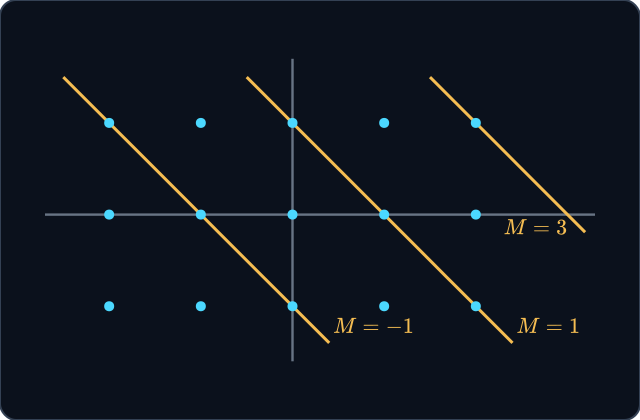
The fifteen product states of and , drawn at . Along each dashed line is fixed: one state has , three have and three have — the count grows by one per step down from the top, then stays at . A coupled state of given is a superposition of the products on its line.
Two bases for two angular momenta
Let and act on different parts, with quantum numbers and . Their sum is again an angular momentum, and the space has two natural bases.
Properties
- The uncoupled states are the common eigenstates of ; the coupled ones of .
The total is an angular momentum
Expand the commutator of the sums into four commutators. The two that mix the parts vanish, because operators on different parts commute; the other two are the commutators of each part, whose sum is times the total -component. The other two relations follow in the same way.
Proof steps
Write out the sums.
The commutator is linear in each slot.
Operators on different parts commute.
Each part is an angular momentum.
Applications
Practice
The Projections Add
The total -component is the sum of the parts’ -components, so each product state has a definite , the sum of its two values.
Try it
A product state has and . What is its ?
The Total Is an Angular Momentum
Because the two parts’ operators commute with each other, the commutators of the sum are the sums of the commutators: the total obeys the same relations as each part.
Try it
The sum of two angular momenta acting on different parts of a system obeys the same commutation relations as each of them.
Two Complete Sets
The uncoupled basis diagonalises each part’s magnitude and -component. The coupled basis diagonalises each part’s magnitude, the total magnitude and the total -component.
Try it
Which operators have the coupled states as common eigenstates?
What Does Not Commute
The total squared contains the cross term , whose and parts turn the first part’s -component into the second’s. So the total squared does not commute with either part’s -component.
Try it
commutes with .
Try it
For and , how many product states have ?
Try it
Two parts interact through a term proportional to . Which basis makes it diagonal?
Try it
For and , what is the largest value of ?
Final checkpoint
Try it
A coupled state is expanded in the uncoupled basis. Which product states can appear?
Try it
The coupled and the uncoupled bases span different spaces.
Try it
Which product state is also a coupled state, for any two angular momenta?
Completion
Lesson complete
Great work! You now know how to:
- show that the sum of two angular momenta is an angular momentum
- tell the coupled basis from the uncoupled one and say which operators each diagonalises
- choose the basis an interaction between the parts calls for