Intuition
Multiply a linear equation by the right function of the input and its left-hand side becomes the derivative of a single product. After that one integration finishes the job. The right function is the exponential of the integral of the coefficient of the unknown, and it is called the integrating factor; this lesson is about using it, and the next is about why it works.
A lock whose key is cut from the lock itself. The coefficient p is already in the equation, and exponentiating its integral makes the one multiplier that folds a sum of two terms into a single derivative.
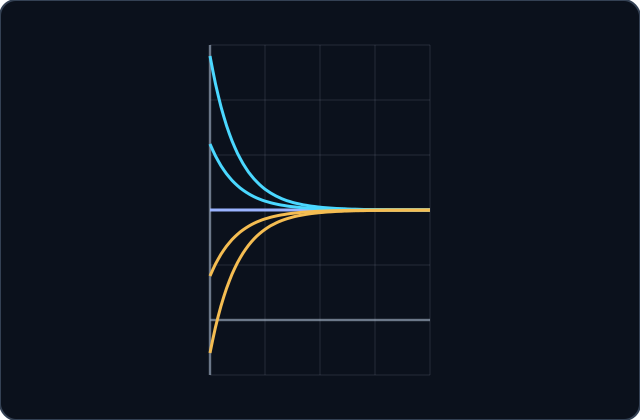
Solutions of . The factor gives , and whatever the starting value the term in dies away: every solution settles at two.
The method in four lines
For , let . Multiplying by turns the left-hand side into . Integrating gives , and dividing by gives the general solution. Any antiderivative of will do: adding a constant to it only multiplies by a constant, which divides out.
Worked, and the places it goes wrong
- For : , , so and .
Applications
Practice
Exponentiate the Integral of p
The integrating factor is built from alone, once the equation is in standard form.
Try it
What is an integrating factor for ?
Try it
What is the general solution of ?
Try it
When computing , the constant of integration in can be left out.
Try it
What is an integrating factor for on ?
The Constant Before Dividing
The constant of integration appears when is integrated, and it is divided by along with everything else.
Try it
A student solving writes , so , and then adds to get . What went wrong?
Try it
For on , take the solution with . What is ?
Try it
After multiplying by , the left-hand side equals .
Try it
What is the general solution of ?
Final checkpoint
Try it
Every solution of approaches the same value as grows. What is it?
Try it
To solve a student takes . What is wrong?
Try it
Every first-order linear equation with continuous and can be solved by an integrating factor, at least up to an integral.
Completion
Lesson complete
Great work! You now know how to:
- compute the integrating factor from p, with the right sign
- turn the left-hand side into the derivative of a product and integrate
- put the constant in before dividing, so the whole family survives
- find the level every solution settles at when the coefficients are constant