Intuition
Some first-order equations are what you get by differentiating a relation. If F(x, y) = C describes a curve, differentiating along it gives an equation whose solutions are exactly the level curves of F: the rate of change of F in x, plus its rate of change in y times the slope, is zero. An exact equation is one that can be recognised as coming from such an F, and solving it means recovering F.
A contour map. Walking along a contour line your height never changes. An exact equation says how height changes in each direction and asks for the contours; its solutions are the contours.
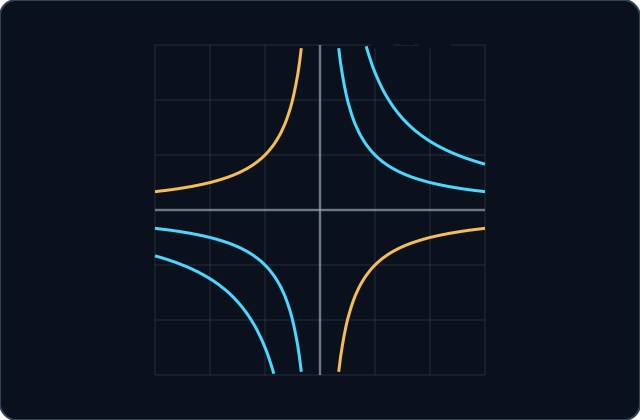
The equation is exact: it is what differentiating along a curve gives. Its solutions are the level curves , drawn for and .
Equations that are a derivative along a curve
Write a first-order equation as , which means . It is exact if some function , called a potential, has and . Then along any solution , so is constant on it: the solutions are the level curves .
What to know
- A partial derivative differentiates in one variable holding the other fixed: for , and . This, with the chain rule along a curve, is all the multivariable calculus the chapter uses, and it is taken on trust.
Level curves of a potential are solutions
Take a solution and follow the potential along its graph. The chain rule for a function of two variables, each depending on x, says the rate of change of F along the curve is its partial in x plus its partial in y times y prime. By exactness those partials are M and N, and M plus N times y prime is zero because y solves the equation. A function with zero derivative on an interval is constant, so the graph lies on one level curve.
Proof steps
The chain rule for a function of two variables along a curve.
Exactness replaces the partial derivatives by M and N.
That is zero because y solves the equation.
A function with zero derivative on an interval is constant, so the solution lies on a level curve of F.
Applications
Practice
Partial Derivatives, Briefly
For a function of two variables, is its derivative in with held fixed, and its derivative in with held fixed.
Try it
For , what is ?
Exact Means a Potential Exists
is exact when some has and .
Try it
Which function is a potential for ?
Try it
The solutions of an exact equation are the level curves of its potential.
Try it
Which of these is written in the form ?
Try it
The solutions of are . For the solution through , what is ?
Try it
Whether an equation is exact can depend on how it is written.
Try it
Which multiplier makes exact?
Try it
The exact equation has solutions . Why leave them implicit?
Final checkpoint
Try it
For the potential , what is at the point ?
Try it
What does it mean for to be exact?
Try it
Every piece of a level curve of the potential that is the graph of a differentiable function solves the exact equation.
Completion
Lesson complete
Great work! You now know how to:
- take a partial derivative, holding the other variable fixed
- recognise an exact equation from a potential
- say why its solutions are the level curves of the potential
- find the level curve through a given point