Intuition
A linear equation has a whole family of solutions, one for each value of the constant, and an initial condition picks one. The order of work matters: find the general solution first, then use the condition to fix the constant — never fix a constant in the middle of a derivation. Afterwards check two things: that the answer satisfies both the equation and the condition, and on which interval it is valid.
Two tanks with identical plumbing, brine flowing in and mixture flowing out at the same rate. The equation describes the plumbing; how much salt each tank held at the start is a separate fact. The two follow different curves to the same final state.
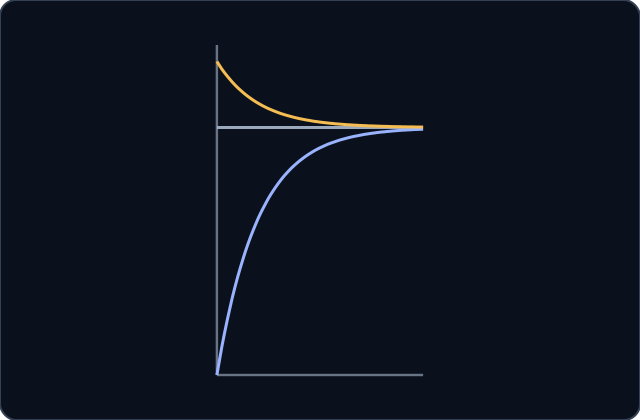
Salt in a -litre tank fed brine at grams per litre, litres a minute, and drained at the same rate: . Whether the tank starts with fresh water or saltier than the brine, the salt approaches grams — what ten litres of the incoming brine would hold.
General solution first, condition last
To solve with , find the general solution, substitute and , and solve for the constant. With definite integrals from the constant is built in. The solution exists and is unique on the largest interval containing on which and are continuous.
Doing it, and where it lives
- For with : the general solution gives , so and .
Applications
Practice
Family First, Condition Last
Find the general solution with its constant still free, then substitute the initial point and solve for the constant.
Try it
Solve with .
Try it
For with , what is ?
Try it
The solution of with is valid on the whole real line.
Salt In, Salt Out
Salt arrives at the inflow rate times the incoming concentration, and leaves at the outflow rate times the concentration in the tank, which is the amount divided by the volume.
Try it
A -litre tank is fed brine with grams of salt per litre at litres a minute and drained at the same rate. Which equation governs the salt , in grams?
Try it
For , what amount does the salt approach in the long run?
Try it
Solving with , a student multiplies by , integrates to and concludes . What is wrong?
Try it
A linear initial value problem with continuous and has exactly one solution on the interval where they are continuous.
Try it
With definite integrals, the solution of with can be written with its constant already fixed. Which is it?
Final checkpoint
Try it
Tea at degrees cools in a room at degrees by , with time in minutes. What is the temperature after minutes?
Try it
What is the largest interval on which the solution of with is guaranteed to exist?
Try it
For , the value of affects the value that approaches as grows.
Completion
Lesson complete
Great work! You now know how to:
- solve a linear initial value problem, general solution first and condition last
- write the solution with definite integrals so the condition is built in
- find the interval on which the solution is guaranteed to exist
- set up and solve a mixing problem