Intuition
Once the test passes, the potential is recovered in two integrations and one comparison. Integrate M in x, holding y fixed: that gives F up to a function of y alone, because anything that depends only on y vanishes when differentiated in x. Then differentiate the result in y and match it with N, which pins down the missing function. The solutions are the level curves of F.
Rebuilding a hill from two sets of survey notes, one giving the east–west slope everywhere and the other the north–south slope. The east–west notes give the shape of every east–west slice but not how the slices sit relative to one another; the north–south notes fix that last piece.
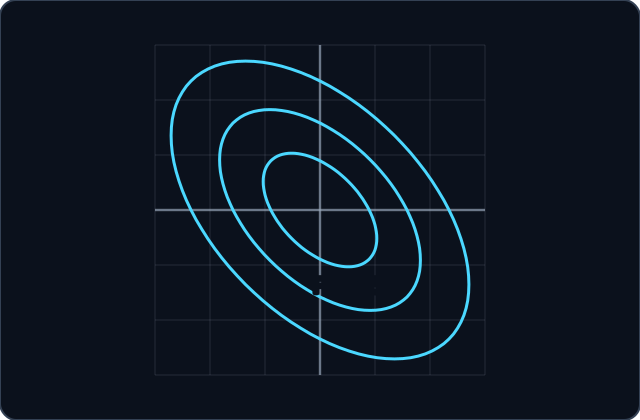
The exact equation has potential , and its solutions are the level curves : tilted ellipses, drawn for , and .
Integrate, differentiate, match
For an exact : integrate in with fixed, adding an unknown ; differentiate the result in and set it equal to ; the equation that results gives as a function of alone — if it does not, the equation is not exact or an integration went wrong; integrate for and write .
The steps, and the check
- For : , then gives , , and .
Why the missing function depends on y alone
After integrating M in x, the candidate G has G_x = M. What is still missing is the difference between N and G_y, and the construction needs it to depend on y alone so that it can be g prime. Differentiate it in x: N_x minus the mixed derivative of G, which may be taken in the other order and is then M_y. The test says N_x equals M_y, so the derivative in x is zero and the difference depends on y alone. That is exactly where the test enters the construction.
Proof steps
Integrate M in x with y held fixed.
What is still missing is the part of N that G does not produce.
Differentiate in x and swap the order of the mixed derivative.
The exactness test makes this zero, so h depends on y alone.
Adding an antiderivative of h gives F with both partial derivatives right: a potential.
Applications
Practice
Integrate M, Keep a Function of y
Integrating in treats as a constant, so the constant of integration may be any function of .
Try it
For , integrating in gives which expression?
Try it
With and , what is ?
Try it
If comes out depending on , the equation is exact but its potential is not elementary.
Try it
What are the solutions of ?
Try it
For with , what is in ?
Try it
Starting from and integrating in instead gives a potential that differs by at most a constant.
Try it
What is a potential for ?
Try it
With the potential , which constant gives the solution through ?
Final checkpoint
Try it
For an equation with and , a student finds and then . What does that show?
Try it
With an initial condition , the solution of an exact equation lies on the level curve .
Try it
The exact equation has potential . What is ?
Completion
Lesson complete
Great work! You now know how to:
- integrate M in x and keep an unknown function of y
- find that function by matching the derivative in y with N
- say why the test guarantees the missing function depends on y alone
- pick out the level curve through an initial point