Intuition
A first-order equation is linear when the unknown and its derivative appear only to the first power, each multiplied by a function of the input. That restriction sounds technical, and it is the most useful thing to know about an equation: every first-order linear equation can be solved, by one method, on any interval where its coefficients are continuous. The first step is always the same — divide by the coefficient of the derivative and read off the two functions that are left.
A savings account whose interest rate changes from month to month and whose deposits vary too. The balance grows in proportion to itself, at a rate that depends on the date, and is topped up by an amount that depends only on the date. Nothing else about the balance matters, and that is what linear means.
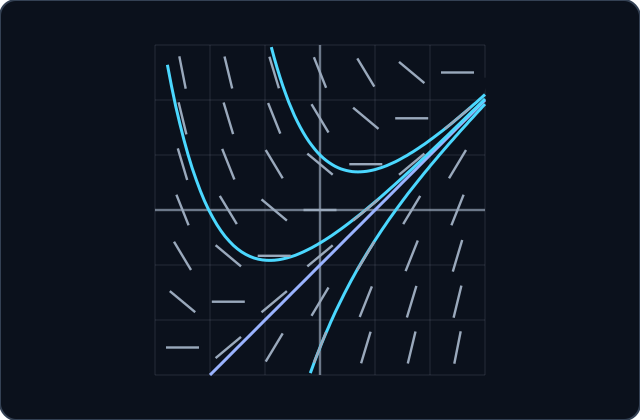
The field of , which is in standard form. Every solution is , and as the input grows the term in dies away: all of them close in on the one line .
Standard form, and the two functions in it
A first-order equation is linear when it can be written . Dividing by , on an interval where it is not zero, puts it in standard form . The function is the forcing: when the equation is homogeneous, and otherwise it is non-homogeneous.
Reading an equation
- The unknown and its derivative appear to the first power and are never multiplied together or put inside another function. is linear; and are not.
Two solutions differ by a solution of the homogeneous equation
Subtract one equation from the other. The forcing q is the same on both right-hand sides and cancels. On the left, the derivative of a difference is the difference of the derivatives, and p times a difference is the difference of the products, so what remains is the homogeneous equation for the difference. Every solution is therefore one particular solution plus a solution of the homogeneous equation, which is the shape of every answer in this chapter.
Proof steps
Start from two solutions of the same non-homogeneous equation.
Subtract the second equation from the first: the forcing cancels.
The derivative of a difference is the difference of the derivatives, and p comes out of the other two terms.
So any solution is a given one plus a solution of the homogeneous equation.
Applications
Practice
First Power, Coefficients in the Input
A linear first-order equation has the unknown and its derivative to the first power, each multiplied by a function of the input alone.
Try it
Which of these first-order equations is linear?
Divide First
Standard form has the coefficient of equal to one. Divide every term by it before reading off and .
Try it
Put in standard form for . What is ?
Try it
The linear equation always has the solution .
Try it
In standard form, what is the forcing of ?
Try it
If and both solve , then solves it too.
Try it
Given that solves and solves , what is the general solution of ?
Try it
For which constant is a solution of ?
Try it
The function solves for every constant . What is ?
Final checkpoint
Try it
Which of these is not linear, whatever the functions of the input in it?
Try it
The difference of two solutions of solves .
Try it
What is for written in standard form?
Completion
Lesson complete
Great work! You now know how to:
- recognise a first-order linear equation
- put it in standard form and read off p and q with their signs
- tell a homogeneous equation from a forced one
- explain why every solution is one particular solution plus a homogeneous one