Intuition
With the axioms in hand, a topology can be written down directly: name a set, name a collection of its subsets, and check three conditions. Spaces built this way need not come from any distance at all, and the small ones can be listed in full — which makes them the cheapest place to test a claim.
A committee decides which groups of people count as close, subject to three procedural rules. Nobody measures anything; the minutes are the whole of the structure.
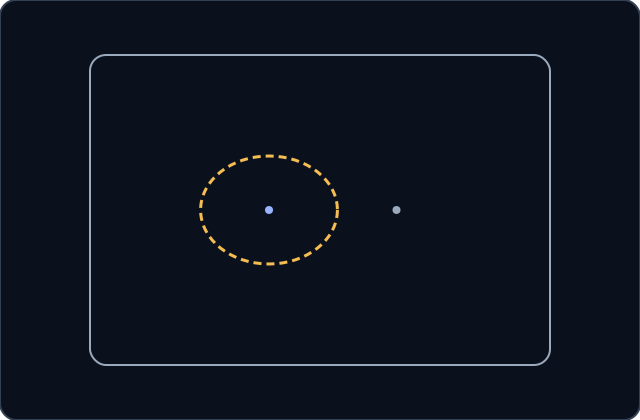
The Sierpiński space: two points, and the open sets , and . The axioms hold — the union and the intersection of any of these is again one of them — and no metric produces it, since lies in no open set except the whole space. A topology this small can be checked by listing everything.
Writing a topology down
A topological space is a pair : a set, and a collection of its subsets satisfying the three axioms. On a finite set the collection can be listed, and the axioms checked case by case. Two families are worth meeting at once: the Sierpiński space above, and the cofinite topology, in which a set is open when it is empty or leaves out only finitely many points.
Small spaces, and what they show
- On there are exactly four topologies: the indiscrete one, the discrete one, and the two Sierpiński spaces and .
The cofinite collection is a topology
Complements turn the conditions into statements about finite sets. The complement of the whole space is empty and so finite, and the empty set is admitted outright. The complement of a union is the intersection of the complements, which is contained in any one of them and so is finite as soon as one of the sets is non-empty. The complement of a finite intersection is a finite union of finite sets, which is finite. Each axiom becomes a fact about finite sets that needs no topology at all.
Proof steps
The two sets the first axiom demands are there: one by the finiteness test, the other by the definition itself.
To test a union, look at its complement, which De Morgan turns into an intersection of the complements.
That intersection sits inside the complement of any one non-empty member, which is finite, so it is finite too.
For a finite intersection the complement is a finite union of finite sets.
So that complement is finite as well, and all three axioms hold.
Applications
Practice
Three Checks and No More
To decide whether a listed collection is a topology, check the two forced sets, then unions, then intersections of finitely many.
Try it
On , which collection is a topology?
Try it
How many topologies are there on the two-point set ?
Try it
In the Sierpiński space on , which open sets contain ?
Try it
On a finite set, the cofinite topology is the discrete topology.
The Cofinite Topology
Declare a set open when it is empty or misses only finitely many points. On an infinite set this is a topology unlike any metric one.
Try it
On with the cofinite topology, which set is open?
Try it
In the cofinite topology on an infinite set, two non-empty open sets always meet.
Try it
Why can no metric produce the Sierpiński topology on ?
Try it
On with the cofinite topology, how many open sets are there?
What You Learned
- A topology is a set together with a listed collection of subsets satisfying three axioms.
- On there are four topologies; the two Sierpiński ones come from no metric.
- The cofinite topology is a topology on any set, and is discrete exactly when the set is finite.
- Small spaces are where a general claim is cheapest to test.
Final checkpoint
Try it
The collection on is not a topology. Which axiom does it break?
Try it
A collection of subsets can satisfy the union axiom and still fail to be a topology.
Completion
Lesson complete
Great work! You now know how to:
- write a topology down by listing its open sets;
- check a proposed collection against the three axioms;
- use the Sierpiński and cofinite topologies as examples;
- give a topology that comes from no metric.