Intuition
Three kinds of point sit around a set. Inside, with room to spare; outside, with room to spare; and on the boundary, where every open set around the point meets both the set and its complement. A fourth question is asked separately: does the point have the set crowding it, even without counting the point itself? Those are the accumulation points, and they are what the closure adds.
Stand in a country: you are inland, abroad, or on the border, where every map you draw shows both. Whether the border belongs to the country is a separate matter, and different sets answer it differently.
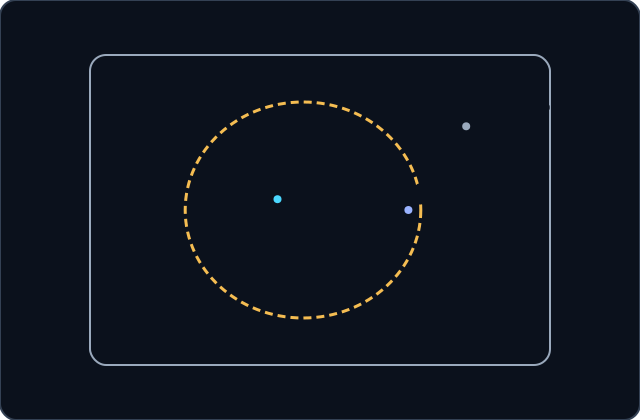
The three positions. An interior point has a whole open set inside ; an exterior point has one inside the complement; a boundary point has neither, so every open set around it meets both. The three are disjoint and together they are the whole space, whatever is.
Boundary, accumulation, isolation
Let . A point is an accumulation point of when every open set around it meets somewhere other than at the point itself; the collection of them is written and called the derived set. A point of that is not one is isolated in . The boundary is what is left of the closure when the interior is taken away.
How they fit together
- , which the theorem below proves. So a set is closed exactly when it already contains its accumulation points.
- On the line : the boundary does not notice whether the endpoints belong. And , because every interval meets both the fractions and their complement.
The closure is the set together with its accumulation points
Each side is contained in the other. A point of A is in the closure already, and an accumulation point has every open set around it meeting A, which is the criterion for the closure proved in the last lesson. Conversely take a point of the closure that is not in A: every open set around it meets A, and since the point itself is not in A, the meeting happens elsewhere, so the point is an accumulation point. The case split is on whether the point belongs to A, and it is the whole of the argument.
Proof steps
A set always lies inside its closure, so one half of the union is there for free.
An accumulation point meets A in every open set around it, which is the criterion for lying in the closure.
For the other inclusion take a point of the closure outside A.
Every open set around it meets A, and the meeting cannot be at x, because x is not in A.
So such a point is an accumulation point, and the two sides contain each other.
Applications
Practice
Three Positions, One Point
Every point of the space is interior to , exterior to , or on its boundary — and exactly one of the three.
Try it
When does a point lie on the boundary of ?
Try it
On the real line, what is ?
Try it
in the standard topology.
Accumulation Points
A point is an accumulation point of when crowds it: every open set around it meets away from the point itself.
Try it
What are the accumulation points of in ?
Try it
has no accumulation points in .
Try it
Which set is , for in ?
Try it
In , how many points does have?
Try it
exactly when is both open and closed.
What You Learned
- : the points where neither side has room.
- when every open set around meets away from ; .
Final checkpoint
Try it
For in , which triple is right?
Try it
A set always contains its accumulation points.
Completion
Lesson complete
Great work! You now know how to:
- compute the interior, closure and boundary of a set;
- decide whether a point is an accumulation point or isolated;
- use ;
- connect an empty boundary with being both open and closed.