Intuition
The line and the plane carry one topology so familiar that it is worth pinning down: the sets built from open intervals and open discs. Everything later in the course is tested against it, and it has a description that will become the idea of a basis — every open set is a union of the simple ones.
A language with a small vocabulary can still say a great deal, because sentences are built by joining words. Open intervals are the vocabulary of the line, and unions are the only grammar there is.
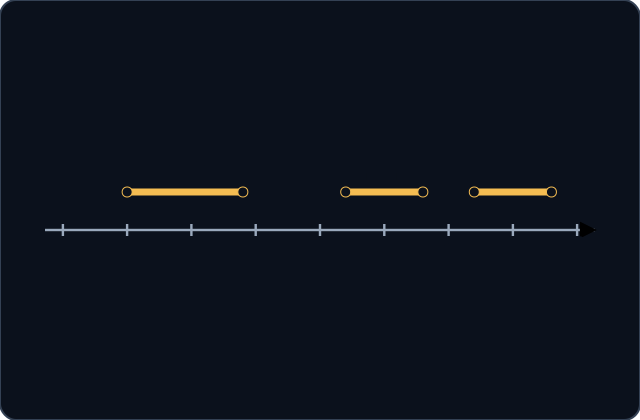
An open subset of the line: a union of open intervals, drawn with hollow ends because the endpoints are missing. Every open set of looks like this, and the union may be of infinitely many pieces — which is how a set like , or the complement of the whole of , is open.
The standard topology
The standard topology on is the one chapter 1 produced from the metric : a set is open when each of its points has an interval around it inside . On the same definition with discs — or with squares, which give the same answer — produces the standard topology of the plane. Being open is membership of this collection, so the question is always open in which topology.
What is open and what is not
- is open and is not: no interval around stays inside the closed one. is open at no end that matters — it fails at — so it is not open either.
Every open subset of the line is a union of open intervals
One direction collects the intervals the definition already provides: each point of an open set has one inside the set, and the union of all of them is the set itself, since every point belongs to its own interval and no interval leaves the set. The other direction is the union axiom: an open interval is open, and a union of open sets is open. So the open sets of the line are exactly what unions of intervals can reach.
Proof steps
Openness hands each point an interval around it inside the set.
Every point lies in its own interval, so the union catches all of them.
Each of those intervals was chosen inside the set, so their union cannot leave it.
Conversely an interval is open and the union axiom makes any union of open sets open.
Applications
Practice
Room At Every Point
A subset of the line is open when each of its points has an interval around it inside the set. One bad point is enough to spoil it.
Try it
Which subset of is open?
Try it
is an open subset of .
Try it
Which of these is open in ?
Try it
Which subset of is open?
Try it
The Euclidean and taxicab metrics give the same open sets on .
Try it
How many open intervals are needed to write as a union?
Try it
Why is every open subset of a union of open intervals?
Try it
Whether is open depends on which topology carries.
What You Learned
- The standard topology on the line: open means every point has an interval around it inside.
- Every open subset of the line is a union of open intervals, possibly infinitely many.
- , a point and a line in the plane are not open; open discs, squares and unions of intervals are.
- Different metrics can produce the same topology.
Final checkpoint
Try it
Which statement about is true in ?
Try it
In the standard topology on , a finite set is never open.
Completion
Lesson complete
Great work! You now know how to:
- decide whether a subset of the line or plane is open;
- write an open set as a union of open intervals;
- name sets that are open in one topology and not in another;
- see why several metrics can give one topology.