Intuition
In the line and in every finite-dimensional real space, compactness has a description anyone can check: closed and bounded. That is the Heine–Borel theorem. It is a theorem about those spaces and not a definition of compactness — two lessons ago gave a closed bounded metric space that is not compact — and keeping the two apart is the point of this lesson.
In one country a passport is proof of citizenship. That is a fact about the country, not the meaning of citizenship, and travellers who forget the difference get into trouble at other borders.
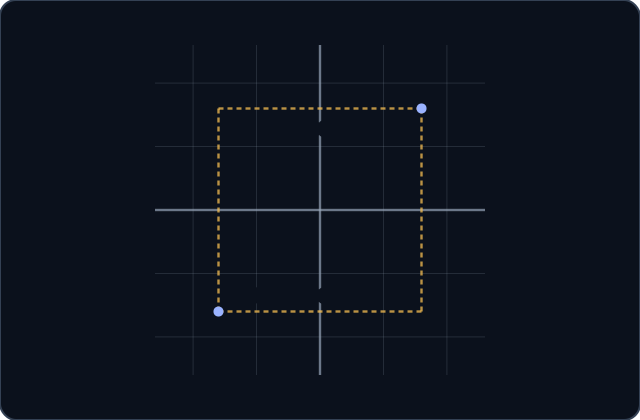
The route to Heine–Borel in the plane: is a product of two compact intervals and so is compact, a bounded set sits inside such a box, and a closed subset of a compact space is compact. The corners are drawn solid because they belong — without them the set would not be closed, and the theorem would not apply.
Closed and bounded, in Euclidean space only
A subset of is compact exactly when it is closed and bounded. One direction is the metric lesson of this chapter. The other assembles three facts: a closed interval is compact, a finite product of compact spaces is compact, and a closed subset of a compact space is compact.
What it rests on and what it does not say
- is compact. Taken on trust, as it has been since the chapter opened: the proof needs the least upper bound property of , which belongs to the analysis course.
- A product of finitely many compact spaces is compact. Taken on trust as well: the proof for two factors is the tube lemma, and the general case is Tychonoff's theorem, which is beyond this course.
- With those two, a closed box is compact, and a closed bounded is a closed subset of such a box — so it is compact by the theorem of the lesson on compact subsets.
Closed and bounded implies compact in Euclidean space
Boundedness puts the set inside a closed box. Each side of the box is a closed interval, which is compact — the fact this course takes on trust — and a finite product of compact spaces is compact, which is the second fact on trust. So the box is compact. The set is closed in the whole space, so it is closed in the box, and a closed subset of a compact space is compact. That last step is the one this chapter proved, and the two borrowed facts are named where they are used.
Proof steps
Boundedness means the set fits inside a ball, and a ball fits inside a box.
The one-dimensional fact, taken on trust because its proof needs the least upper bound property.
A finite product of compact spaces is compact, the second fact taken on trust.
A closed set stays closed in a subspace containing it, since closed sets of a subspace are traces.
A closed subset of a compact space is compact — proved earlier in this chapter.
Applications
Practice
Closed and Bounded, in This One Family
In — and only in spaces like it — compactness is exactly closed and bounded.
Try it
What does the Heine–Borel theorem say?
Try it
Which facts does the proof of the hard direction use?
Try it
Heine–Borel holds in every metric space.
Try it
Which subset of is compact?
Try it
The unit circle is compact.
Try it
How many of the three conditions — closed, bounded, non-empty — must a subset of satisfy to be compact?
Try it
In , which of these are equivalent?
What You Learned
- In : compact exactly when closed and bounded.
- The proof uses a compact interval and a finite product, both on trust, and a closed subset of a compact space.
- The theorem fails in a general metric space, and the counterexamples are ordinary.
- In compactness, sequential compactness and closed-and-bounded all agree.
Final checkpoint
Try it
Why is it wrong to define compactness as closed and bounded?
Try it
Every closed bounded subset of is compact.
Completion
Lesson complete
Great work! You now know how to:
- state Heine–Borel and the three facts its proof uses;
- decide compactness of a subset of the plane;
- name the two facts this chapter takes on trust;
- say why closed and bounded is not the definition of compactness.