Intuition
There is a second way to say that a space leaves no room to escape: every sequence in it has a subsequence that converges inside it. This is sequential compactness, stated in sequences rather than in covers. In a metric space the two properties coincide, which is why analysis can use either; in general spaces they part company.
A crowded room forces any queue of people to bunch up somewhere. Counting patrols and watching queues are different measurements that, in familiar rooms, always agree.
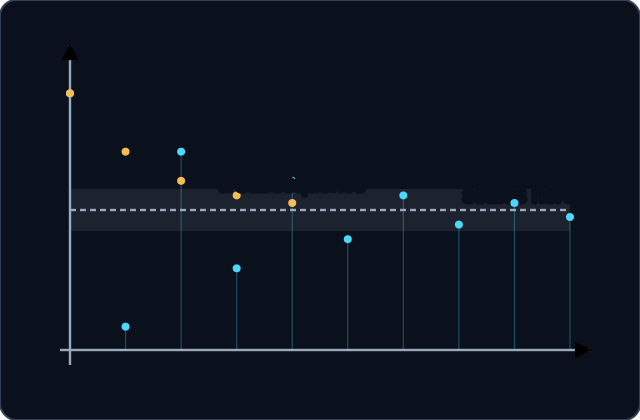
The sequence does not converge — it keeps changing sign — and the terms at odd indices form a subsequence that converges to . Sequential compactness asks for one such subsequence for every sequence, with its limit inside the space.
Compactness stated in sequences
A space is sequentially compact when every sequence of its points has a subsequence converging to a point of the space. In a metric space this is equivalent to compactness. The equivalence is taken on trust here: one direction needs an argument about total boundedness, and the other needs a cover built from a sequence with no convergent subsequence; both belong to a later course.
What it gives, and where it differs
- is not sequentially compact: has no subsequence converging inside it, since every subsequence heads for .
- is not sequentially compact either: the sequence has no convergent subsequence at all.
A sequentially compact metric space is complete
Take a Cauchy sequence. Sequential compactness hands over a subsequence converging to a point of the space. Chapter 1 proved that a Cauchy sequence with a convergent subsequence converges, and to the same limit. So every Cauchy sequence converges inside the space, which is completeness. The whole proof is two facts joined, and it is worth seeing because it shows what the sequence language buys.
Proof steps
Take any Cauchy sequence; completeness is the claim that it converges in the space.
Sequential compactness supplies a convergent subsequence with its limit inside.
This is the theorem of the lesson on complete metric spaces in chapter 1.
So the sequence converges in the space, and the space is complete.
Applications
Practice
Every Sequence Has a Settling Subsequence
Sequential compactness asks that every sequence have a subsequence converging to a point of the space.
Try it
What does sequential compactness demand?
Try it
Which space is not sequentially compact?
Try it
A sequentially compact metric space is complete.
Try it
In which spaces are compactness and sequential compactness known to agree?
Try it
This course proves that compactness and sequential compactness agree in a metric space.
Try it
How many points can a subsequence of a convergent sequence in a metric space converge to?
Try it
Which fact is the Bolzano–Weierstrass theorem, as this course states it?
What You Learned
- Sequentially compact: every sequence has a subsequence converging inside the space.
- In metric spaces it is equivalent to compactness — taken on trust here.
- is sequentially compact (Bolzano–Weierstrass, on trust); and are not.
- A sequentially compact metric space is complete.
Final checkpoint
Try it
A metric space is sequentially compact. Which of these does not follow?
Try it
In the sequence has a subsequence converging to a point of the space.
Completion
Lesson complete
Great work! You now know how to:
- state sequential compactness;
- name spaces that have it and spaces that do not;
- prove that it implies completeness in a metric space;
- say which equivalence this course takes on trust and why.