Intuition
Compactness was defined for a space, and a subset is called compact when it is compact in the topology it inherits. That reads as a statement about open sets of the subset; it can also be read as a statement about open sets of the space around it, and the two agree. The second reading is the one used in practice, because it needs no traces.
A field can be inspected with a map of the field or with a map of the county. The inspection reaches the same verdict either way, and the county map is the one in the glove box.
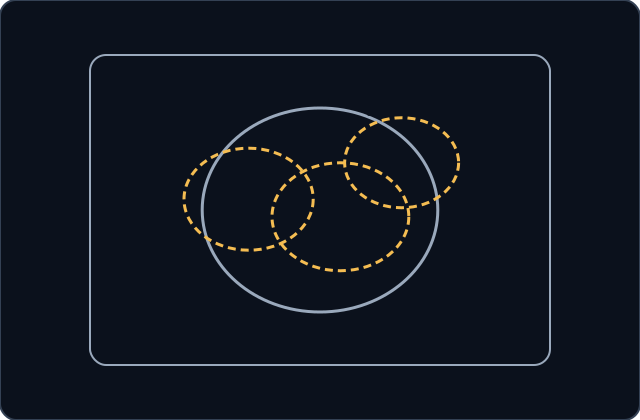
A cover of the subset by open sets of the whole space . Meeting each of them with gives a cover by open sets of the subspace, and thinning either one thins the other — so compactness of can be tested with the open sets of and never needs the traces written down.
Two ways to test a subset
A subset is compact when the subspace is a compact space. Equivalently: whenever a family of open sets of covers , finitely many of them already cover . Such a family is called a cover of by open sets of , and the equivalence below is what lets it be used.
What is compact, and what follows
- A finite subset is compact, and so is a finite union of compact subsets: thin each piece and put the finitely many choices together.
- A closed subset of a compact space is compact, which the theorem below proves; the complement of the subset is the extra open set the proof needs.
- A convergent sequence together with its limit is compact: any open set catching the limit catches all but finitely many terms, and one more set per remaining term finishes the cover.
- is not compact in : the intervals cover it and no finite subfamily does.
A closed subset of a compact space is compact
Take a cover of the closed set by open sets of the space. It need not cover the space, and what it misses lies outside the closed set — so adding the complement of the closed set, which is open, gives a cover of the whole space. Compactness thins that to finitely many members. Throwing the complement away again leaves finitely many members of the original cover, and they still cover the closed set, because the complement contributed none of its points.
Proof steps
Start from a cover of the closed subset by open sets of the space.
Adding the open complement of the subset turns it into a cover of the whole space.
Compactness of the space thins that cover to finitely many members.
The complement covers no point of the subset, so it can be discarded.
What is left is a finite subfamily of the original cover, covering the subset.
Applications
Practice
Cover From Inside or From Outside
Covering by open sets of and covering it by open sets of the subspace are the same test: the traces of one family are the other.
Try it
. Which statement is equivalent to compactness of the subspace ?
Try it
A union of two compact subsets is compact.
Try it
A closed subset of a compact space is compact.
Try it
Why is not a compact subset of ?
A Sequence With Its Limit
is compact: one member of the cover catches and therefore all but finitely many terms.
Try it
Is compact in ?
Try it
A cover of by the intervals is given. What is the smallest subcover?
Try it
In every topological space, a compact subset is closed.
What You Learned
- A subset is compact when every cover of it by open sets of the space thins to finitely many.
- Finite sets, finite unions of compact sets and closed subsets of compact spaces are compact.
- A convergent sequence with its limit is compact; is not.
- Compact does not imply closed in a general space.
Final checkpoint
Try it
is compact and . Which condition makes compact?
Try it
An open subset of a compact space is compact.
Completion
Lesson complete
Great work! You now know how to:
- test a subset for compactness with open sets of the space;
- prove that a closed subset of a compact space is compact;
- give compact and non-compact subsets of the line;
- see that compact does not yet imply closed.