Intuition
So far the state has moved and the observables have stood still. The opposite bookkeeping works just as well: freeze the state at its initial value and let every observable move instead. This is the Heisenberg picture, and its equations of motion look like the classical ones — the rate of change of an observable is its commutator with the Hamiltonian.
Walking past a statue, or standing still while the statue is carried past you: the view is the same. The Schrödinger picture moves the state past fixed observables, the Heisenberg picture moves the observables past a fixed state.
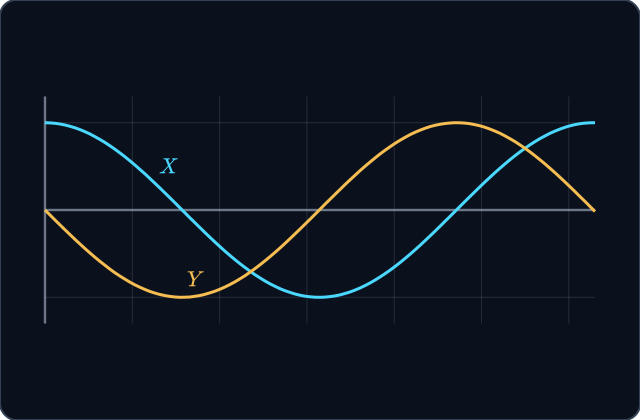
The averages of and against for the state under . In the Heisenberg picture the operator itself turns, , and the averages in the fixed state follow.
Moving operators instead of states
In the Heisenberg picture the state is fixed at and each observable is replaced by . Every expectation value comes out the same as in the Schrödinger picture, and the observables obey Heisenberg's equation of motion.
The two pictures
- Averages agree: .
Heisenberg’s equation of motion
Differentiate the product with the product rule and use the Schrödinger equation for and for its adjoint. Because commutes with , the two terms combine into a commutator with .
Proof steps
The product rule, for an with no explicit time dependence.
The Schrödinger equation for and its adjoint.
Substitute.
is a function of , so they commute.
Move to the outside of each term.
Applications
Practice
The Operator Moves
In the Heisenberg picture the state stays at its initial value and each observable is transformed by the evolution operator on both sides.
Try it
In the Heisenberg picture, what depends on time?
The Same Predictions
Moving the evolution operators from the state onto the observable does not change any bracket: both pictures give the same averages.
Try it
The Heisenberg and Schrödinger pictures can give different expectation values for the same observable at the same time.
Heisenberg’s Equation
The rate of change of an observable in the Heisenberg picture is its commutator with the Hamiltonian, times .
Try it
Which observables do not change in the Heisenberg picture?
A Turning Operator
Under the Hamiltonian , the operator in the Heisenberg picture turns into a combination of and .
Try it
Under , what is at in the state , where and at ?
Try it
In the Heisenberg picture the Hamiltonian itself changes with time.
Try it
in the Schrödinger picture. What is ?
Try it
. In the Heisenberg picture at , what multiple of is ?
Final checkpoint
Try it
.
Try it
Under with per second, after how many seconds does first return to ? Give three decimal places.
Try it
Why is the Heisenberg picture called the closest to classical mechanics?
Completion
Lesson complete
Great work! You now know how to:
- move the time dependence from the state onto the observables
- derive and use Heisenberg’s equation of motion
- show that both pictures give the same predictions