Intuition
An eigenstate of the Hamiltonian barely evolves: it only turns its phase, at a rate set by its energy. Since a global phase is invisible, nothing measurable about it ever changes — every probability and every average stays exactly what it was. Such states are called stationary, and finding them is most of the work of the rest of the course.
A lighthouse beam sweeps round and round, yet the lighthouse never changes: the turning is all in the phase. A stationary state turns its phase and is otherwise still.
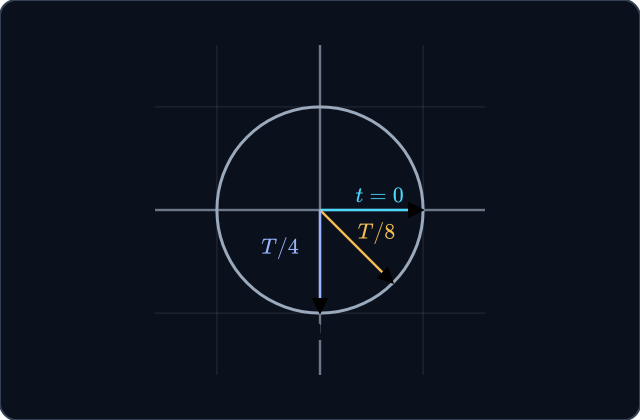
The factor of a stationary state at three times, as an arrow in the complex plane. It turns clockwise with period and never changes length, so no probability built from the state ever changes.
States of definite energy
If , the Schrödinger equation is solved by multiplying by a turning phase. Every expectation value and every probability in such a state is independent of time. The equation for the energy eigenstates themselves is the time-independent Schrödinger equation.
What stays still
- for every observable, because the phase and its conjugate cancel.
Stationary states have constant averages
Check first that the turning phase solves the Schrödinger equation: differentiating brings down , which the turns into , exactly what gives. Then in any expectation value the phase from the ket meets its conjugate from the bra and they cancel.
Proof steps
Differentiate the phase.
Because : the Schrödinger equation holds.
The bra carries the conjugate phase.
The phases cancel, leaving a number independent of .
Applications
Practice
Only the Phase Turns
An eigenstate of the Hamiltonian with energy evolves by being multiplied by a phase that turns at the rate .
Try it
A system starts in the energy eigenstate . What is its state at time ?
Nothing Measurable Changes
In a stationary state every probability and every expectation value is constant in time, because the only change is a global phase.
Try it
In a stationary state, the probability of finding the particle in some region can change with time.
The Phase Period
The phase of a stationary state returns to its starting value after a time .
Try it
With , a stationary state has energy . After what time does its phase first return to its starting value?
Only Eigenstates Are Stationary
A superposition of two different energies has two phases turning at different rates. Their relative phase changes, and with it the probabilities.
Try it
Which state is stationary?
Try it
A stationary state can carry a steady flow of probability.
Try it
In a stationary state, at . What is at ?
Try it
What is the time-independent Schrödinger equation?
Final checkpoint
Try it
The period of a single stationary state can be measured.
Try it
A particle in a stationary state has probability 0.35 of being found in some region at . What is that probability at ?
Try it
Why do stationary states explain the stability of atoms?
Completion
Lesson complete
Great work! You now know how to:
- solve the Schrödinger equation for an energy eigenstate
- prove that every expectation value in it is constant
- recognise the time-independent Schrödinger equation as an eigenvalue problem