Intuition
The Hamiltonian is the observable of energy, and it is also what drives time evolution. Its eigenvalues are the energy levels of the system. Two identical states that the system can tunnel between — a nitrogen atom above or below the plane of an ammonia molecule — are the simplest example: the coupling between them splits one energy into two.
Two identical pendulums joined by a weak spring no longer swing at one frequency but at two, one for swinging together and one for swinging opposite. Coupling two quantum states does the same to their energy.
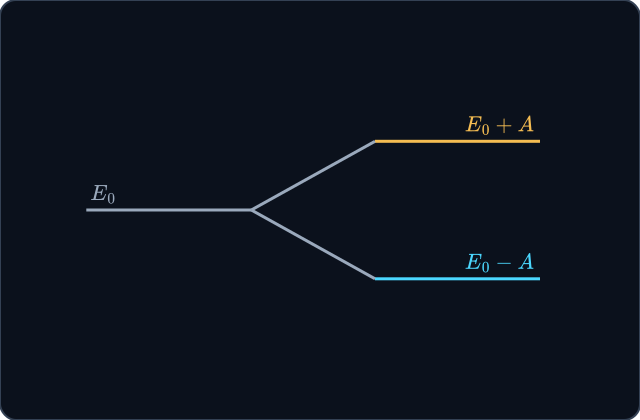
Without tunnelling, the two positions of ammonia's nitrogen share one energy . The coupling splits it into , the even combination, and , the odd one. In ammonia the gap is about eV, and the photons it emits are the 24 GHz radiation of the first maser.
The energy observable
The Hamiltonian is the Hermitian operator whose eigenvalues are the possible energies of a system, and it generates the system's evolution in time. For a two-state system with equal energies and a coupling between the states, it is a symmetric matrix.
Energy levels
- The eigenvectors are the even and odd combinations: with and with , for .
Coupling splits the level
Write the characteristic equation of the Hamiltonian. It is a difference of two squares, whose roots lie symmetrically about at distance . Putting each root back picks out the even and the odd combination of the two states.
Proof steps
The determinant of the matrix.
Take square roots.
Each row of the matrix acting on gives .
And on it gives .
Applications
Practice
The Energy Observable
The Hamiltonian is the observable whose eigenvalues are the energies the system can have. The same operator appears in the Schrödinger equation.
Try it
What are the eigenvalues of the Hamiltonian?
Two Coupled States
Two states of equal energy coupled by an amount split into two levels, one below and one above the original energy.
Try it
A two-state Hamiltonian has meV on both diagonal entries and meV off the diagonal. What is the gap between its two levels, in meV?
Even Is Lower
With a negative coupling between the two states, the even combination has the lower energy and the odd one the higher.
Try it
For with , which state has the lowest energy?
Only Differences Matter
Adding the same constant to every energy multiplies every state by a common phase in time, which no measurement can see.
Try it
Adding a constant to the Hamiltonian changes the probabilities of some measurements at later times.
Try it
A molecule drops from a level at to one at with eV. Using eV s, what is the frequency of the photon, in GHz? Give one decimal place.
Try it
In the ammonia Hamiltonian with , the state has a definite energy.
Try it
An electron can sit on either of two identical atoms, with coupling , . Which combination is the bonding orbital?
Final checkpoint
Try it
In the ammonia two-state system with meV and meV, what is in the state , in meV?
Try it
The same operator that gives the energy levels also governs the time evolution of the state.
Try it
If the coupling were instead of , with , what would change?
Completion
Lesson complete
Great work! You now know how to:
- read the Hamiltonian as the energy observable
- find the split levels of two coupled states
- say why only energy differences are measurable