Intuition
Put a system in a superposition of two energies and each part turns its phase at its own rate. The relative phase between them turns at the difference of the two rates, and the probabilities swing back and forth at that frequency — the Bohr frequency. An ammonia molecule started with its nitrogen on one side tunnels to the other and back again, over and over.
Two tuning forks of slightly different pitch, sounded together, swell and fade at a slow beat equal to the difference of their frequencies. Two energies in a superposition beat in exactly the same way.
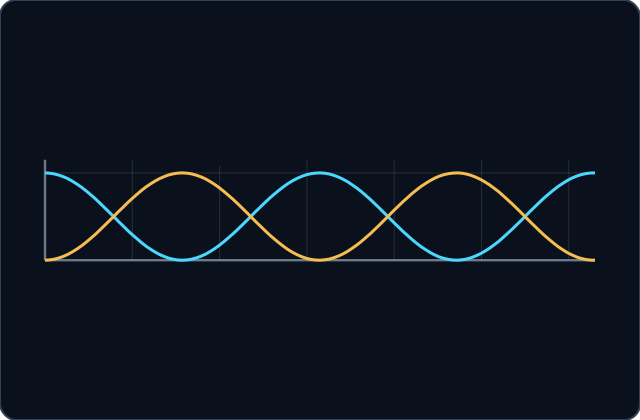
The probabilities of finding ammonia's nitrogen on the left and on the right, against , for a molecule started on the left: and . The nitrogen tunnels across and back at the Bohr frequency .
The general solution
Expand the initial state in energy eigenstates; each component turns at its own rate. Probabilities and averages then contain cross terms with the relative phases, which oscillate at the Bohr frequencies, the differences of energies over .
What oscillates
- The probabilities of the energies themselves, , never change.
- An observable that connects two levels, with , has an average oscillating at .
Ammonia tunnels back and forth
Write as the sum of the even and odd energy eigenstates, attach to each its own phase, and take the overlap with again. The two phases, , combine into a common phase times a cosine of .
Proof steps
The left state is the sum of the two energy eigenstates.
Each part turns at its own rate.
.
Euler's formula for the cosine.
The common phase drops out of the modulus squared.
Applications
Practice
The Bohr Frequency
In a superposition of two energies the relative phase turns at the difference of the energies divided by , and observables that connect the two levels oscillate at that rate.
Try it
A superposition of levels at and is prepared. At what angular frequency do its probabilities oscillate?
Tunnelling Across
Started on the left, ammonia’s nitrogen is certainly on the right when reaches a quarter turn, .
Try it
With and , when is the nitrogen, started on the left, first certainly on the right? Give three decimal places.
Energy Probabilities Stay Put
The probability of each energy is the modulus squared of its coefficient, and the coefficients only gain phases. So the energy distribution never changes.
Try it
In a superposition of two energies, the probability of measuring each energy oscillates at the Bohr frequency.
Reading the Oscillation
Started in , the probability of at a later time is .
Try it
For ammonia started on the left, what is at ?
Try it
Which initial state of ammonia produces no oscillation of ?
Try it
Two levels are separated by in units where . What is the period of the beats?
Try it
Every solution of the Schrödinger equation with a time-independent Hamiltonian is a superposition of stationary states.
Final checkpoint
Try it
In a superposition of and , the average of an observable oscillates only if which condition holds?
Try it
With and , at what earliest time after does ammonia started on the left have ? Give three decimal places.
Try it
Adding the same constant to every energy level changes the frequency of the beats.
Completion
Lesson complete
Great work! You now know how to:
- evolve a superposition of energy eigenstates
- find the Bohr frequency of its oscillations
- derive the tunnelling of ammonia back and forth