Intuition
The course has written one theory in several languages. Schrödinger’s wave mechanics: a wavefunction and a differential equation. Heisenberg’s matrix mechanics: fixed states, operators that move, and the commutator . Dirac’s notation, in which is one set of components of an abstract vector and another, joined by a Fourier transform. Feynman’s path integral: the amplitude as a sum over histories. Each makes some questions easy and others hard, and they are one theory because each represents the same objects. The propagator is the position matrix element of the evolution operator; the path integral is a way of computing it; and its Fourier transform in time is the resolvent , whose poles are the energy levels and whose form for a free particle is the outgoing Green function of scattering. The pictures agree on every prediction because predictions are traces and inner products, which do not care which basis is used or whether the state or the operator carries the time.
A city can be given as a street map, an aerial photograph or a list of addresses. Each answers some questions faster than the others, and all describe the same city.
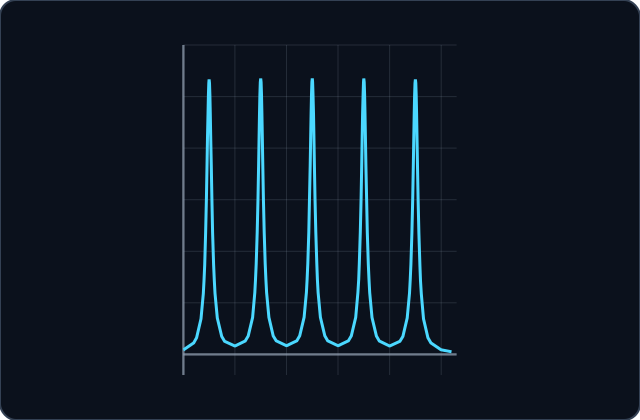
for an oscillator, with across in units of and : a peak of width at each level . As the peaks become the spectrum.
One theory, several representations
The evolution operator in the position representation is the propagator, and its Fourier transform in time, with outgoing waves picked by a small , is the resolvent:
Properties
- and are the components of one vector in two bases, joined by the Fourier transform.
The resolvent is the Fourier transform of the evolution
Work in the eigenbasis of , where the evolution operator multiplies each eigenstate by a phase. The time integral of each phase, damped by , is elementary and gives . Summed over the eigenstates with their projectors, this is the resolvent, and in the position representation the same sum shows its poles at the levels, with the stationary states as residues.
Proof steps
The spectral decomposition of the evolution operator.
The upper limit gives nothing, since damps it.
Put the terms together.
The spectral decomposition of the inverse; a continuous spectrum turns the sum into an integral.
In the position representation: a pole at every level, with the stationary states as residues.
Applications
Practice
Components of One Vector
and are the components of the same vector in two bases, and the Fourier transform turns one into the other.
Try it
How are the position and momentum wavefunctions of a state related?
Poles at the Levels
The resolvent has a pole at every energy level, and in position its residues are the stationary states.
Try it
At what energy, in eV, does the resolvent of hydrogen have its lowest pole? Give one decimal place.
Pictures
The Schrödinger and Heisenberg pictures move the time dependence between the state and the operators; every expectation value comes out the same.
Try it
The Heisenberg picture predicts different expectation values from the Schrödinger picture for the same system.
The Small \varepsilon
The factor makes the time integral converge; its sign picks outgoing waves, and at the end.
Try it
With and , what is ?
Two Routes to One Propagator
The path integral sums over histories; the Schrödinger equation evolves . Both give the same propagator.
Try it
How are the path integral and the Schrödinger equation related?
Try it
For a free particle, the position matrix element of the resolvent is an outgoing spherical wave , up to a constant.
Try it
A position wavefunction is moved along the line by . By what number is its momentum wavefunction multiplied at the momentum with ?
Final checkpoint
Try it
What did Heisenberg’s matrix mechanics and Schrödinger’s wave mechanics turn out to be?
Try it
The resolvent of a free particle has poles at isolated energies.
Try it
Which formulation makes the classical limit most plain?
Completion
Lesson complete
Great work! You now know how to:
- connect the wave, matrix, abstract and path-integral formulations
- derive the resolvent from the evolution operator
- read the energy levels off the poles of the Green function