Intuition
A course’s worth of quantum mechanics rests on a few statements about states. A state is a ray in a Hilbert space — or, when it is prepared at random or is part of something larger, a density matrix. It evolves by a unitary operator, continuously and reversibly. A measurement gives one eigenvalue of the observable, with the Born probability, and leaves the matching eigenstate. The two rules seem to clash: the Schrödinger equation is linear and reversible, while a measurement picks one outcome and cannot be undone. Describe the measuring device by quantum mechanics too and the clash becomes precise. A good device copies each eigenstate into a reading of its own; linearity then carries a superposition into an entangled superposition of every reading — Schrödinger’s cat. Decoherence explains why no one sees that superposition: the readings are recorded again and again in the environment, and what is left of the system looks exactly like a mixture with the Born weights. Which reading a single run shows, the equations do not say. The interpretations part there — Copenhagen takes the collapse as a rule for using the theory, many-worlds keeps every branch, pilot-wave theory adds definite positions guided by the wavefunction, collapse theories change the dynamics — and all agree on every prediction tested so far. What none can restore is local realism: Bell’s inequality, violated in experiment, rules out outcomes fixed in advance by local causes.
A forecast of 70 per cent rain cannot say whether it will rain on your street tomorrow, and the uncertainty is ignorance of the weather’s details. Quantum probabilities look the same and are not: Bell’s theorem shows that no local set of hidden details can produce them.
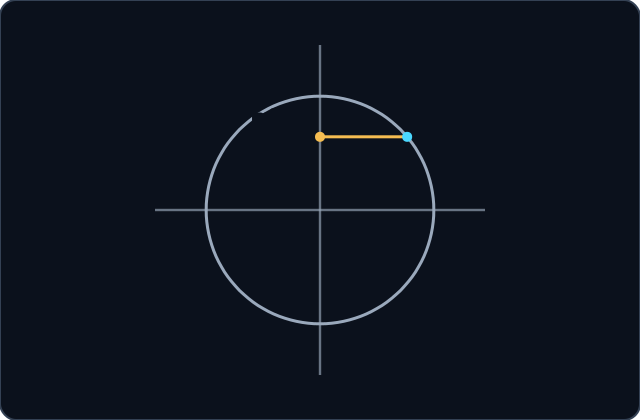
A cut through the Bloch ball, up. A qubit in a pure state on the sphere, at from the axis, is recorded by a device in the basis and the reading is not looked at: its Bloch vector drops straight to the axis, at the height . Looking at the reading then leaves it at one pole.
The postulates, and measurement inside the theory
The rules of the course, with a measuring device treated as a quantum system that records each eigenstate of the measured observable in an orthonormal reading :
Properties
- A state is a unit vector up to a phase, or a density matrix when it is mixed or part of a larger system; every prediction is a probability or an average .
- Evolution is unitary and reversible; a measurement gives one eigenvalue with the Born probability and leaves the matching eigenstate.
- Treated by the Schrödinger equation, a measurement entangles the system with the device: the readings decohere, and the system alone is left in the Born mixture.
- Which reading a single run shows is not fixed by the unitary evolution. This is the measurement problem, answered differently by the Copenhagen, many-worlds, pilot-wave and collapse interpretations, which agree on every prediction tested.
- Bell’s inequality, violated in experiment, rules out local hidden variables, and entanglement still cannot carry a signal.
Measurement inside the theory
A good measurement leaves each eigenstate of the observable alone and moves the device to a reading of its own. Linearity then fixes what it does to a superposition: an entangled sum over every reading. Tracing out the device leaves the system’s coherences multiplied by the overlaps of different readings, which vanish; what remains is the mixture with the Born weights. Which reading a single run shows, the calculation does not say.
Proof steps
A good measurement leaves each eigenstate alone and gives the device a reading of its own.
Linearity: a superposition goes to an entangled superposition of every reading, never to one reading alone.
The partial trace over the device multiplies each coherence by the overlap of two readings.
Orthogonal readings remove every coherence; the weights left are the Born probabilities.
The mixture gives the statistics; what a single run shows is the question the interpretations answer differently.
Applications
Practice
The Born Rule
A measurement gives the eigenvalue with probability and leaves the state . A device that records the outcome without being read leaves the Born weights on the diagonal of the density matrix.
Try it
A qubit in is recorded by a device in orthogonal readings, and the reading is not looked at. What is of the qubit afterwards?
Linearity
A device that records as reading 0 and as reading 1 turns a superposition into an entangled superposition of both readings.
Try it
A measuring device that obeys the Schrödinger equation meets a qubit in a superposition of the two states it records. What state results?
Not Ignorance
Bell’s inequality, violated in experiment, shows that quantum probabilities cannot come from values fixed in advance by local causes.
Try it
Quantum probabilities could come from each particle carrying definite values set in advance by local causes, of which quantum mechanics is merely ignorant.
Decoherence
Each coherence is multiplied by the overlap of the device’s readings: orthogonal readings remove it, partly overlapping ones only shrink it.
Try it
A qubit with is recorded by a device whose two readings overlap, . What is afterwards?
Interpretations
Copenhagen, many-worlds, pilot-wave and collapse theories answer the measurement problem differently, and agree on every prediction tested so far.
Try it
What do the interpretations of quantum mechanics disagree about?
Try it
Measuring one particle of an entangled pair cannot change the statistics of measurements made on the other.
Try it
A qubit with its Bloch vector at to the axis is recorded in the basis, and the reading is not looked at. What is the length of its Bloch vector afterwards?
Final checkpoint
Try it
What is the measurement problem?
Try it
Decoherence explains which outcome a single measurement gives.
Try it
When must a system be described by a density matrix rather than a state vector?
Completion
Lesson complete
Great work! You now know how to:
- state the postulates and how they fit together
- describe a measurement inside quantum mechanics and derive the Born mixture
- say what decoherence explains and what the interpretations dispute