Intuition
The course began with one particle and one qubit, and ended with fields. The thread between is short. Two systems combine by the tensor product, so dimensions multiply. The combined space holds entangled states, which have no description part by part. Identical particles use only its symmetric or antisymmetric part. When their number can change, Fock space collects every number, and when there are infinitely many modes, or the particles are relativistic, the natural object is a field whose quanta are the particles. The multiplying dimensions are both the power and the difficulty of quantum mechanics. spins one-half need complex amplitudes, while a product state needs only two numbers per spin, so almost every state is entangled, and no classical memory can hold the general state of three hundred spins — which is what quantum computers use. Physics usually escapes the explosion by approximation: Hartree–Fock and other mean fields treat each particle in the average of the others, perturbation theory builds on a solvable part, and many real ground states carry only limited entanglement.
One coin has two faces; ten coins have 1024 arrangements; three hundred coins have more arrangements than there are atoms in the observable universe. A quantum state of spins must give an amplitude to every arrangement.
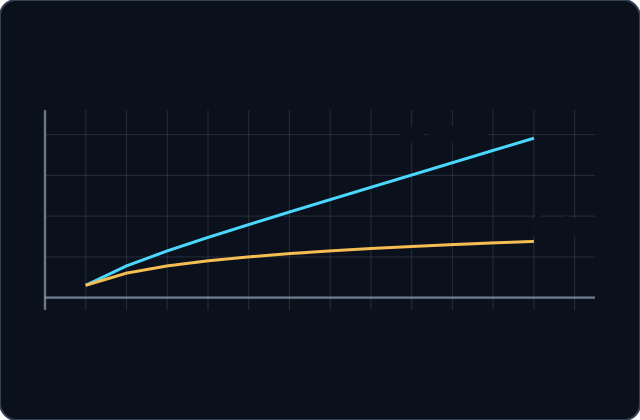
The number of real parameters of a pure state of qubits, as its logarithm to base 10, against from 1 to 12: every state, , and product states, , dashed. At twelve qubits it is 8190 against 24.
How the state space grows
For distinguishable systems of states each, and for identical particles and fields:
Properties
- Dimensions multiply under the tensor product, while the parameters of a product state only add.
- A general state of qubits needs complex amplitudes and a product state real parameters, so almost every state is entangled.
- Identical particles use only the symmetric or antisymmetric subspace; Fock space collects every particle number, and each mode of a field carries an occupation.
- Mean-field methods such as Hartree–Fock replace the many-body state by a product or a single determinant, keeping the counting in hand at the price of the correlations.
- A quantum computer of qubits holds a state that a classical memory would need amplitudes to store; about 300 qubits would need more numbers than there are atoms in the observable universe.
Almost every state is entangled
A state of qubits is a unit vector of complex amplitudes, taken up to an overall phase: real numbers, less one for the normalisation and one for the phase. A product state is one state for each qubit, a point on its Bloch sphere with two real parameters. For the products form a set of lower dimension, which has no volume in the whole: a state picked at random is entangled.
Proof steps
Dimensions multiply under the tensor product.
The real and imaginary part of each amplitude, less the normalisation and the overall phase.
Each qubit’s state is a point on its Bloch sphere: two angles.
The general states outrun the products, faster the more qubits there are.
A set of lower dimension has no volume in the larger one: a state chosen at random is entangled.
Applications
Practice
Dimensions Multiply
Combining systems takes the tensor product of their spaces, and the dimensions multiply: qubits have basis states.
Try it
How many basis states do 10 qubits have?
Mostly Entangled
A pure state of qubits has real parameters and a product state only : almost every state is entangled.
Try it
A pure state of 20 qubits is picked at random. What is it, almost certainly?
Mean Fields
Hartree–Fock keeps a single Slater determinant, a state of manageable size, and loses the correlations beyond it.
Try it
Hartree–Fock describes a many-electron state exactly.
Counting Parameters
A pure state of qubits needs real numbers once the normalisation and the overall phase are removed.
Try it
How many real parameters does a general pure state of 3 qubits have?
Identical Particles
Identical particles use only the symmetric or the antisymmetric part of the tensor product.
Try it
Which part of the tensor product of single-particle spaces do identical fermions use?
Try it
Fock space collects the states of every particle number, and the quanta of a field are counted by the occupations of its modes.
Try it
How many more real parameters does a general pure state of 4 qubits have than a product state of 4 qubits?
Final checkpoint
Try it
Why can a classical computer not store a general state of 300 qubits?
Try it
The dimension of the state space of two systems is the sum of their dimensions.
Try it
When are fields, rather than wavefunctions of a fixed number of particles, the natural description?
Completion
Lesson complete
Great work! You now know how to:
- follow the state space from one particle to many and on to fields
- count the parameters of general and of product states
- say why many-body quantum mechanics is hard and how it is approximated