Intuition
Through the course one idea kept returning. A symmetry is a unitary operator — or, for time reversal, an antiunitary one — that commutes with the Hamiltonian. A continuous symmetry has a Hermitian generator, and that observable is conserved, labels the states and forbids transitions. Translations give momentum; rotations give angular momentum, with equal energies in every level and the selection rules of the Wigner–Eckart theorem; translations in time give energy; parity gives the rule that a dipole joins only states of opposite parity; time reversal gives Kramers pairs; gauge invariance forces the vector potential into the Hamiltonian and conserves charge; exchange symmetry sorts particles into bosons and fermions; Lorentz symmetry shaped the Klein–Gordon and Dirac equations. Even hydrogen’s accidental degeneracy has a symmetry behind it, the conserved Runge–Lenz vector. This lesson proves the three consequences of one commutator, , together: is conserved, and share eigenstates, and has no matrix element between eigenstates of with different eigenvalues. In a basis sorted by the Hamiltonian falls into blocks, each diagonalised on its own — which is why the radial equation is one-dimensional, and why hydrogen could be solved at all.
In a library sorted by subject, a question about physics never sends you to the poetry shelves. A symmetry sorts the states the same way, and the Hamiltonian never leaves a shelf.
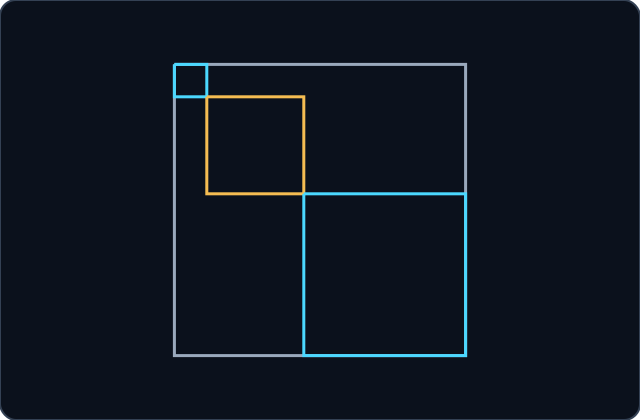
The matrix of a Hamiltonian that commutes with rotations, in a basis of states with , and sorted by from the top left: every entry outside the three blocks along the diagonal is zero, so each block of states is diagonalised on its own.
One commutator, three consequences
A symmetry with a Hermitian generator , , commutes with exactly when its generator does:
Properties
- Conservation: , Noether’s theorem in quantum mechanics.
A symmetric Hamiltonian is block-diagonal
Take the matrix element of the commutator between two eigenstates of . Acting to the left and to the right, gives its eigenvalues, so the matrix element of the commutator is times that of . The commutator is zero and is not, so the matrix element of vanishes. With the conservation that Heisenberg’s equation gives and the common eigenbasis of compatible observables, this is the whole content of a symmetry.
Proof steps
The matrix element of the commutator between eigenstates of .
is Hermitian, so on the bra it gives its real eigenvalue .
The commutator vanishes.
In a basis sorted by the matrix of is block-diagonal, and each block is diagonalised on its own.
The same commutator makes conserved.
Applications
Practice
Symmetry and Generator
A continuous symmetry is with a Hermitian generator , and it commutes with the Hamiltonian exactly when does.
Try it
Which observable does invariance under rotations about the axis conserve?
Forced Degeneracy
Symmetries that do not commute with each other force degenerate levels: rotations give each level of angular momentum its states.
Try it
How many states does a level with of a rotation-invariant Hamiltonian hold, apart from any further degeneracy?
Conservation
If commutes with and does not depend on time, Heisenberg’s equation gives : the symmetry’s generator is conserved.
Try it
If and does not depend on time, can still change in time.
Selection Rule
Between eigenstates of a conserved with different eigenvalues the Hamiltonian has no matrix element.
Try it
commutes with . What is ?
Which Symmetry, Which Law
Translations conserve momentum, rotations angular momentum, translations in time energy, and changes of the phase of the wavefunction conserve charge.
Try it
What does invariance under changes of the phase of the wavefunction, made local as gauge invariance, bring with it?
Try it
In a system with time-reversal symmetry and an odd number of electrons, every level is at least doubly degenerate.
Try it
Leaving spin out, how many states does hydrogen’s level hold?
Final checkpoint
Try it
What lies behind the accidental degeneracy of hydrogen’s levels of different ?
Try it
A Hamiltonian that commutes with a symmetry can join eigenstates of the symmetry’s generator that have different eigenvalues.
Try it
Why does an electric dipole transition join only states of opposite parity?
Completion
Lesson complete
Great work! You now know how to:
- connect a symmetry to its generator and its conserved quantity
- derive the block form of a Hamiltonian that has a symmetry
- name the symmetry behind each conservation law, degeneracy and selection rule of the course