Intuition
In 1922 Stern and Gerlach sent silver atoms, each carrying the magnetic moment of one unpaired electron, through a magnetic field that grows stronger in one direction. A magnetic moment in such a field feels a force proportional to its component along the field. Classically the moments would point every way and the beam would smear into a line. It split into two spots. Along any axis the spin has exactly two values, and sending one of the beams through a second apparatus turned another way shows what measurement does to a state.
A sieve that lets through only two sizes of grain, with nothing in between, would tell you that the grains come in two sizes. The Stern–Gerlach magnet is a sieve for the component of spin, and it finds two sizes.
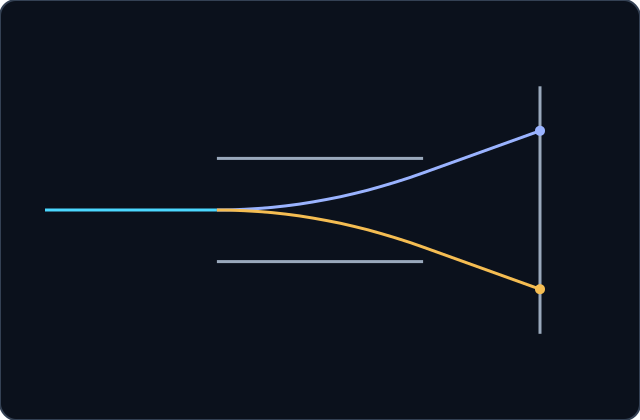
Silver atoms enter from the left and pass between the poles of a magnet whose field grows stronger upwards. Each is pushed up or down according to its spin component along the field, and the beam lands on the screen, on the right, in two spots. Classically it would have smeared into a line.
Measuring a component of spin
A magnetic moment in a field that varies in space feels a force. In a field along that grows with , the force is proportional to , so the atoms are sorted by their spin component along .
What the experiments show
- Two spots for silver: its one unpaired electron has , and the rest of the atom has no angular momentum.
- A beam that left the exit and meets a second apparatus all leaves by again: the measurement prepared the state .
The force that sorts the spins
A magnetic moment in a field has energy , and a force is minus the gradient of an energy. Near the axis of the magnet the field points along and changes with , so only the component of the moment feels a force, in proportion to the field’s gradient.
Proof steps
The energy of a magnetic moment in a field.
A force is minus the gradient of the energy; does not depend on position.
Near the axis of the magnet the field points along .
Differentiate with respect to .
Two values of give two forces, equal and opposite: two spots.
Applications
Practice
Two Spots
Classically the magnetic moments of the atoms would point in every direction, and the beam would spread into a continuous line. For silver it splits into exactly two spots.
Try it
What did Stern and Gerlach see on their screen?
Counting Spots
A particle of spin gives spots in a Stern–Gerlach apparatus, one for each value of .
Try it
How many spots would a beam of particles with spin make?
Measuring Again
Atoms that left the upper exit of a magnet all leave the upper exit of a second magnet: the first measurement prepared the state spin up along .
Try it
Atoms from the upper exit of a magnet along enter a second magnet along . What happens?
A Different Axis
Spin up along , measured along , gives with equal probability.
Try it
Atoms in enter a magnet along . What fraction leaves by the exit?
Try it
Atoms that passed , then , then enter a magnet along all leave by .
Try it
A beam of atoms in passes an magnet, whose beam passes a magnet. About how many atoms leave the last magnet by ?
Try it
Why must the field in a Stern–Gerlach magnet vary in space?
Final checkpoint
Try it
The gradient of the field is doubled. By what factor does the force on each atom change?
Try it
Which state leaves an magnet by the exit with certainty?
Try it
Silver was a good choice because all but one of its electrons pair off, leaving the atom with the spin of a single electron.
Completion
Lesson complete
Great work! You now know how to:
- derive the force on a magnetic moment in a varying field
- read the two spots as spin
- predict what chains of Stern–Gerlach magnets do