Intuition
Rotations act on spin states through the exponentials of the Pauli matrices, and those exponentials have a surprise: because , the exponential of a rotation by is , with half angles. A full turn gives . Objects that change sign under a full turn and need two turns to come back are spinors. The sign cannot be seen on one spin alone, since it is an overall phase, but it shows in interference, and neutrons sent round a magnetic field showed it in 1975.
Hold a cup of water flat on your palm and turn it one full turn under your arm: your arm ends twisted. A second full turn in the same direction untwists it. The arm is a spinor: it needs two turns to come back.
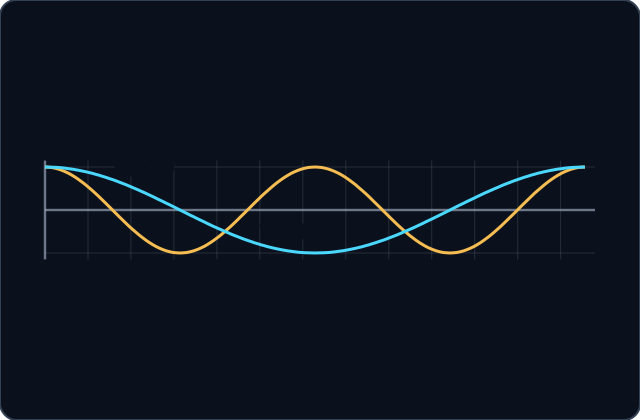
Against the angle of rotation, from 0 to : the component of an ordinary vector returns after one turn, ; the amplitude of a spinor has only reached at and returns after two turns, .
Rotating a spin
A rotation by about the axis acts on spin- states as the exponential of . Since , the series sums in closed form.
Properties
- and , for every axis.
The exponential of a Pauli matrix
Expand the exponential. Every even power of is the identity and every odd power is itself, so the even terms sum to a cosine and the odd ones to a sine.
Proof steps
The Pauli matrices anticommute and square to one.
The exponential series.
Even and odd powers.
The even terms are the series of the cosine, the odd ones of the sine.
A full turn is minus the identity.
Applications
Practice
Minus One After a Turn
A spin one-half rotated by a full turn of about any axis comes back multiplied by . Only a second full turn restores it.
Try it
What number multiplies a spin- state after a rotation by about any axis?
Half Angles
Because , the exponential of a rotation sums in closed form, with half the rotation angle.
Try it
What is the rotation by about acting on spin-?
When the Sign Shows
For a single spin the after a full turn is an overall phase and cannot be seen. When one part of a superposition is turned and another is not, it reverses their interference.
Try it
The a spin acquires in a full turn can be observed by comparing it with a spin that was not turned.
Turning a State
Rotating about the axis by gives : the point on the Bloch sphere moves by the full angle.
Try it
is rotated by about the axis. What is the probability of then finding it up along ?
Try it
How many full turns bring a spin- state back exactly, without a sign?
Try it
A rotation by about the axis acts on . Where does the state end up on the Bloch sphere?
Try it
An orbital wavefunction with also changes sign under a rotation by .
Final checkpoint
Try it
What is the entry of the rotation by about the axis, ? Give the real part to three decimal places.
Try it
Why do half angles appear in the rotation of a spin one-half?
Try it
The matrix has determinant 1 for every and .
Completion
Lesson complete
Great work! You now know how to:
- sum the exponential of a Pauli matrix into cosines and sines
- show that a full turn multiplies a spinor by
- move states on the Bloch sphere by rotations