Intuition
Put a spin in a magnetic field along . Its energy depends only on , so the probabilities of up and down along never change — but the transverse components do: the average spin vector turns about the field at a steady rate, the Larmor frequency, like a gyroscope under gravity. For an electron in one tesla that is about 28 GHz; for a proton about 43 MHz. Magnetic resonance, from chemistry labs to hospital scanners, listens to this precession.
A spinning top tilted in gravity does not fall over but swings its axis round in a circle. A spin in a magnetic field does the same with its average direction, about the direction of the field.
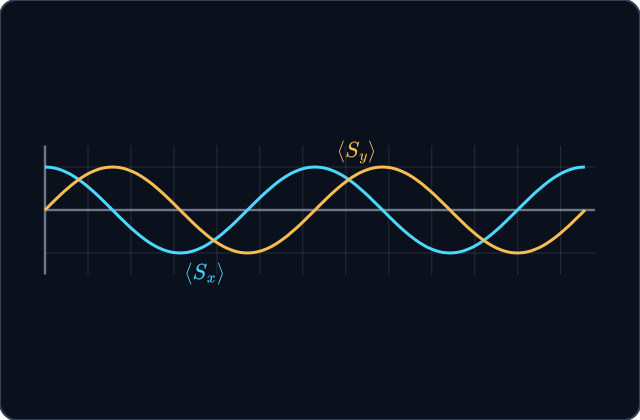
A spin starting as in a field along , with , over two periods of : and , drawn in units of . Meanwhile stays zero: the average spin turns in the plane at right angles to the field.
Larmor precession
A spin with magnetic moment in a field along has . Writing , the average spin turns about at the rate .
Properties
- is constant, since commutes with ; and turn at the rate .
The spin precesses about the field
Heisenberg’s equation needs the commutators of with the transverse components, which the angular momentum algebra supplies. The two equations are those of a vector turning about , solved by a cosine and a sine.
Proof steps
Heisenberg’s equation of motion.
The cyclic commutator.
The same for .
A rotation by about solves both.
The component along the field is conserved.
Applications
Practice
The Larmor Frequency
In a field along , the average spin turns about at the Larmor frequency, the energy splitting divided by . For an electron that is about 28 gigahertz per tesla.
Try it
At about 28 GHz per tesla, at what frequency does an electron spin precess in a field of 0.35 T, in GHz? Give one decimal place.
The Component Along the Field
The Hamiltonian commutes with , so the probabilities of up and down along the field never change. Only the transverse components move.
Try it
In a field along , the probability of finding a spin up along changes in time.
Turning About the Field
Heisenberg’s equations for and are those of a vector turning about at the rate .
Try it
With and , a spin starts as . Where does point a quarter period later?
Protons
A proton’s magnetic moment is far smaller than an electron’s, and it precesses at about 42.6 megahertz per tesla.
Try it
At about MHz per tesla, at what frequency do protons precess in a 3 T scanner, in MHz? Give one decimal place.
Try it
With , a spin starts as . What is at , in units of ?
Try it
A spin tilted only slightly from the field precesses more slowly than one at right angles to it.
Try it
In the Schrödinger picture, what makes a superposition of and precess?
Final checkpoint
Try it
A spin precesses at rad/s. What is its period, in microseconds?
Try it
Which quantity is conserved for a spin in a field along ?
Try it
The two levels of a spin in a field differ by eV. With eV s, at what frequency does it precess, in GHz?
Completion
Lesson complete
Great work! You now know how to:
- derive Larmor precession from Heisenberg’s equations
- compute precession frequencies of electrons and protons
- explain precession as a turning relative phase