Intuition
A Stern–Gerlach magnet can be turned to any direction , and it then measures the spin component . Its outcomes are again , because no direction is special, and its eigenstates are up and down along . A spin prepared up along one axis and measured along another at angle comes out up with probability : certainly at 0, half and half at , never at . The average of the measured component is — exactly the projection a classical arrow of unit length would have.
Shine light polarised at some angle through a polariser: the fraction passing depends only on the angle between them. A spin through a turned Stern–Gerlach magnet obeys the same kind of rule, with half angles in place of whole ones.
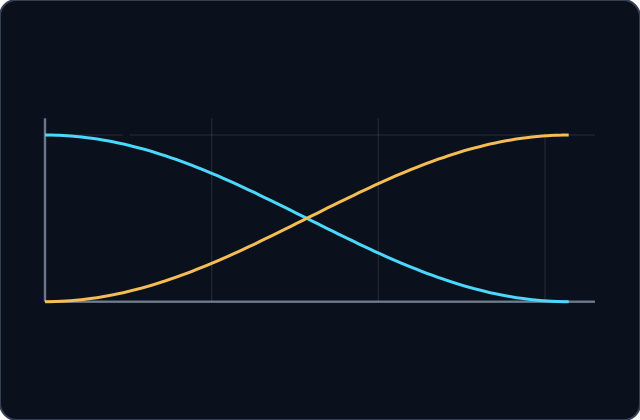
A spin prepared up along and measured along a direction at angle from , for from 0 to : up along with probability , down with . The two curves cross at , where the outcome is a coin toss.
Spin along a direction
For a unit vector the component of spin along is , with eigenvalues .
Properties
- , so its eigenvalues are ; its eigenstate is .
Probability along a turned axis
Write the eigenstate of with eigenvalue and take its overlap with : only the first amplitude survives, and its square is the probability.
Proof steps
The eigenstate of , as multiplying out the matrix confirms.
The bra conjugates the amplitudes, and only the term overlaps.
The measurement postulate, and a double-angle identity.
Outcomes with their probabilities: the projection of on .
Applications
Practice
Half Angles Again
Up along , measured along a direction at angle , gives up with probability .
Try it
A spin up along is measured along a direction at to . What is the probability of the result up?
No Special Direction
The spin component along any direction has the same two eigenvalues, : .
Try it
What values can a measurement of give for ?
Never Down Along Its Own Axis
A spin up along is never found down along ; measured along the opposite direction it is never found up.
Try it
A spin up along can be found up along .
The Average Is a Projection
In the state up along , the average of is , the cosine of the angle between the two directions.
Try it
A spin is up along . What is for at to ?
Try it
For at , , what is the entry of ?
Try it
A spin up along is measured along and found up. What is its state afterwards?
Try it
In every spin- state, the average spin vector has length .
Final checkpoint
Try it
A spin up along is measured along . What is the probability of the result up?
Try it
Which state gives ?
Try it
A spin up along gives up along with probability . What is the angle between and , in degrees, if it is between 0 and 180?
Completion
Lesson complete
Great work! You now know how to:
- write the spin component along any direction as a matrix
- compute the probabilities and
- find the average of a spin component in any state