Intuition
When a Hamiltonian is one we can solve plus a small extra piece, the answer is the solvable answer plus small corrections. Write the extra piece with a parameter that switches it on, expand every energy and state in powers of , and demand that the Schrödinger equation hold at each power separately. The first power gives the first-order corrections, the second power the second, and so on. The expansion works while the extra piece is small compared with the gaps between the unperturbed levels.
A planet’s orbit round the Sun is an ellipse; the pull of the other planets is small, so astronomers compute the ellipse first and then the small corrections to it, order by order. Quantum perturbation theory is the same method, and borrowed its name from astronomy.
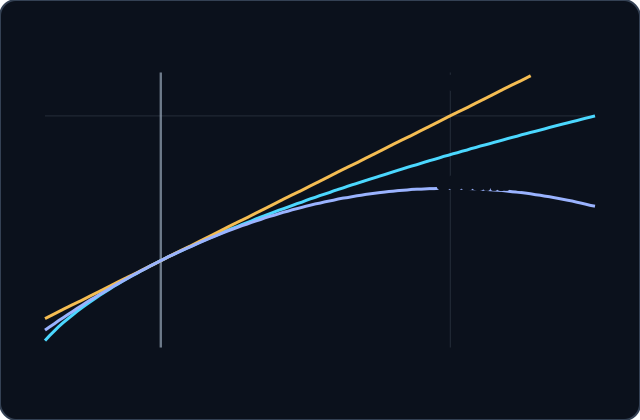
The ground energy of an oscillator with an extra , in units of : exactly . The first-order line and the second-order parabola follow it closely for small and drift away as grows.
The perturbation expansion
Split the Hamiltonian into a solved part and a small perturbation, and expand each eigenvalue and eigenstate in powers of the strength of the perturbation.
Properties
- The states expand the same way: , usually with for .
The equations order by order
Put the two expansions into the eigenvalue equation and multiply out. The equation must hold for every small , so the coefficient of each power of must balance on its own. The zeroth power is the unperturbed problem; the first power is an equation for the first corrections.
Proof steps
Put the expansions in.
The unperturbed problem, already solved.
Collect the terms with one power of .
The first-order equation, which the next two lessons solve.
Applications
Practice
Small Compared With What
Perturbation theory needs the extra piece to be small compared with the gaps between the unperturbed levels it connects, not small in some absolute sense.
Try it
When is perturbation theory reliable?
The Expansion
Each energy is written as the unperturbed one plus a term in , a term in , and so on. The terms are found order by order.
Try it
An oscillator with an extra has exact ground energy in units of . What is its first-order coefficient ?
One Equation per Order
Because the eigenvalue equation must hold for every small , the terms of each power of balance separately. Each order gives an equation that uses the results of the orders before.
Try it
In perturbation theory, the first-order equation involves the second-order corrections.
Try it
For the same oscillator, what is the second-order coefficient of the ground energy?
Try it
Which Hamiltonian is best treated as a solvable part plus a perturbation?
Try it
For , the exact ground energy of the oscillator with an extra is . How far is the second-order estimate from it? Give three decimal places.
Try it
A perturbation series can be useful in its first few terms even if the full series diverges.
Final checkpoint
Try it
A perturbation connects two levels 2 eV apart with a matrix element of 0.02 eV. What is their ratio, the small number perturbation theory relies on?
Try it
What does the zeroth-order equation of perturbation theory say?
Try it
Ordinary perturbation theory can fail for degenerate levels because some of its denominators vanish.
Completion
Lesson complete
Great work! You now know how to:
- split a Hamiltonian into a solved part and a perturbation
- derive the equations of perturbation theory order by order
- judge when the expansion can be trusted