Intuition
The first-order energy shift is the simplest formula in the subject: the average of the perturbation in the unperturbed state. It needs nothing but the state you already have. A particle in a box whose floor is raised on one half has its every level lifted by half the step, because every density in a box spends half its time in each half. An oscillator with a small quartic term has its ground level raised by the quartic’s average.
Raise the floor of half a room by a centimetre and the average height of someone walking about the whole room rises by half a centimetre. To first order, that is all a small perturbation does.
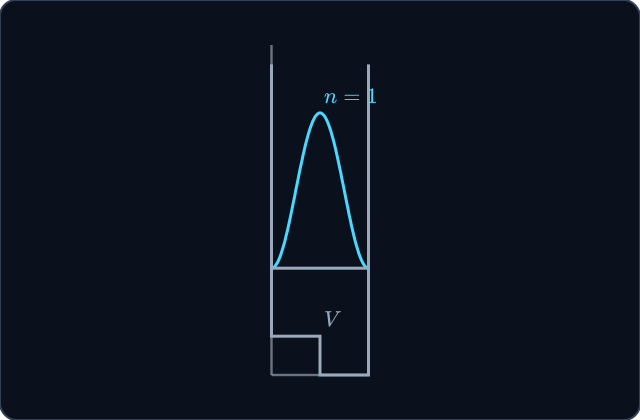
A box whose floor is raised by on its left half, and the density of its ground state drawn above it. The density is symmetric, so exactly half of it lies over the raised half: to first order every level rises by .
The first-order shift
Take the first-order equation and project it on the unperturbed state. The unknown state correction drops out, leaving the shift.
Examples
- A constant perturbation shifts every level by , exactly.
- A box with its floor raised by on one half: every level shifts by to first order.
The first-order energy
Take the inner product of the first-order equation with the unperturbed state. Because is Hermitian, its left side vanishes, and what remains is the first-order energy against the average of the perturbation.
Proof steps
The first-order equation.
Take the inner product with , which is normalised.
is Hermitian and is its eigenstate.
The left side vanishes.
Applications
Practice
An Average in the Unperturbed State
To first order, a level shifts by the average of the perturbation in the unperturbed state.
Try it
A box has its floor raised by eV on the left half. By how much does its third level shift to first order, in eV?
The Quartic Oscillator
In the oscillator ground state the average of to the fourth is three quarters of to the fourth, so a small raises the ground level by three quarters of .
Try it
With , by how much does raise the first excited level of an oscillator, to first order, in units of ?
Odd Perturbations
In a problem symmetric about the origin, a perturbation odd in has zero average in every state of definite parity, so its first-order shift is zero.
Try it
A small field adds to a harmonic oscillator. Its levels shift at first order in .
Only the Diagonal
The first-order energy uses only the diagonal matrix element of the perturbation in the state itself. Couplings to other states matter from second order on.
Try it
Which quantity gives the first-order energy of level ?
Try it
A box from to gains the potential . By how much does each level shift to first order, in units of ?
Try it
A constant perturbation shifts every level by exactly , to all orders.
Try it
In deriving the first-order energy, why does the term with the unknown state correction drop out?
Final checkpoint
Try it
An oscillator with and gains . What is its ground energy to first order?
Try it
For which perturbation of a symmetric well is the first-order shift of the ground state zero?
Try it
The first-order energy shift of a level needs the unperturbed states of the other levels as well as its own.
Completion
Lesson complete
Great work! You now know how to:
- derive the first-order energy shift
- compute it for boxes, oscillators and constant or odd perturbations
- use symmetry to see when it vanishes