Intuition
When several states share an energy, the ordinary formulas divide by zero. The way out is to choose the unperturbed states wisely. Within the degenerate level any combination is an eigenstate of , and the perturbation picks out particular combinations — those that diagonalise it within the level. On them the first-order shifts are the eigenvalues of the small matrix of the perturbation in the level, and the level splits.
Several identical balls resting at the bottom of a flat dish can sit anywhere. Tilt the dish slightly and they roll to definite places; the tilt chooses where they settle. A perturbation chooses the states of a degenerate level the same way.
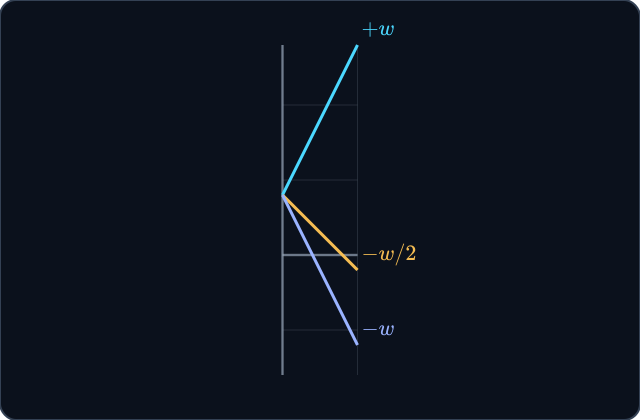
A level holding three states at , split by a perturbation of strength from 0 to 1. To first order each new level moves in a straight line, with a slope equal to an eigenvalue of the perturbation’s matrix within the level.
Degenerate perturbation theory
For a level of degenerate states , form the matrix of the perturbation within it. Its eigenvalues are the first-order shifts; its eigenvectors are the right unperturbed states.
Properties
- The eigenvectors of , the good states, are the limits of the perturbed states as .
- If a symmetry of the perturbation labels the degenerate states differently, is already diagonal in them and the good states are those labels.
- Eigenvalues of that coincide leave part of the degeneracy; the next order may split it.
- The trace of does not depend on the basis, so the shifts add up to whichever states are used: the centre of gravity of the level moves by .
Diagonalising within the level
Write the zeroth-order state as an unknown combination of the degenerate states and project the first-order equation on each of them. The left side vanishes, since each has the same unperturbed energy, and what remains is the eigenvalue equation of the matrix .
Proof steps
Any combination of the degenerate states is an eigenstate of .
The first-order equation.
is an eigenbra with the same energy .
Project the right side on .
The first-order shifts are the eigenvalues of .
Applications
Practice
A Small Matrix
Within a degenerate level, write the perturbation as a matrix. Its eigenvalues are the first-order shifts of the split level.
Try it
A doubly degenerate level has in units of . What is the larger first-order shift?
Division by Zero
The ordinary formulas divide by gaps between unperturbed levels. Within a degenerate level those gaps are zero, so the formulas must be replaced.
Try it
Why does non-degenerate perturbation theory fail for a degenerate level?
The Centre Stays
The trace of , the sum of its eigenvalues, is the sum of its diagonal elements: the average shift of the level is unchanged by choosing good states.
Try it
For the average of the two first-order shifts is zero.
Only Couplings Within the Level
At first order, only the matrix elements between states of the degenerate level itself enter the splitting.
Try it
A level holds and ; a third state lies elsewhere. The matrix of in the order is shown with its entries labelled. Press the entry that couples the two degenerate states.
Try it
A triply degenerate level has in units of . How many distinct first-order levels does it split into?
Try it
With in the degenerate states , which are the good states?
Try it
If a symmetry of the perturbation gives the degenerate states different labels, the matrix is already diagonal in them.
Final checkpoint
Try it
in eV. What is the splitting between the two first-order levels, in eV?
Try it
has a repeated eigenvalue. What does that mean?
Try it
States outside a degenerate level affect its first-order splitting.
Completion
Lesson complete
Great work! You now know how to:
- set up the perturbation matrix within a degenerate level
- find the first-order splittings and the good states
- use symmetry to see when the matrix is already diagonal