Intuition
The perturbation also changes the states: to first order, each state mixes in a little of every other state the perturbation connects it to. Each admixture is the connecting matrix element divided by the energy gap, so near levels mix strongly and far ones weakly. A uniform force on an oscillator shifts its ground-state Gaussian sideways; to first order that shift is a little of the first excited state added in.
A pendulum hanging in a gentle breeze leans slightly downwind. To first order the lean is the breeze’s push divided by the stiffness: the same shape as an admixture, a coupling divided by a gap.
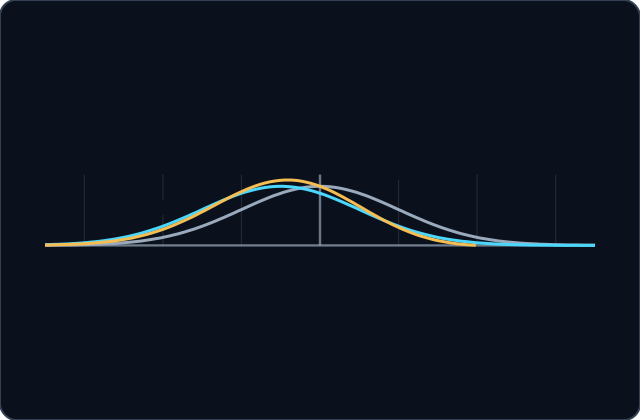
The ground state of an oscillator with an added force, with in units of and : exactly the Gaussian shifted by . First-order perturbation theory adds to , which reproduces the shift for small .
The first-order state correction
Expand the first-order correction in the unperturbed states. Projecting the first-order equation on each other state gives its coefficient.
Properties
- Each admixture is a matrix element over an energy gap: nearby levels mix most.
- It is small only if for every .
The first-order admixtures
Project the first-order equation on another unperturbed state. On the left, acts on the bra and gives its energy; on the right, the term with the first-order energy vanishes by orthogonality. What remains is the coefficient times the energy gap, set equal to the matrix element.
Proof steps
The first-order equation.
acts to the left on its eigenbra.
for .
Divide by the gap, which is not zero for a non-degenerate level.
Applications
Practice
Coupling Over Gap
To first order, a state picks up each other state with a coefficient equal to the connecting matrix element divided by the energy difference.
Try it
A perturbation connects the ground state, , to a state at with matrix element . What is the admixture coefficient of that state in the ground state?
A Pushed Oscillator
For an oscillator with an added force , the only state the perturbation mixes into the ground state is the first excited one.
Try it
Which states does mix into an oscillator’s ground state at first order?
Near Levels Mix Most
Because the admixture divides by the energy gap, a level close in energy mixes in much more strongly than a distant one with the same coupling.
Try it
With equal matrix elements, a state 10 times further away in energy is mixed in 10 times less.
How Much of the Other State
The probability of finding the perturbed state in another unperturbed state is the square of the admixture coefficient, a second-order small number.
Try it
A state has a first-order admixture coefficient of of another level. What is the probability, to lowest order, of finding it in that level? Give five decimal places.
Try it
An odd perturbation acts on the even ground state of a symmetric well. Which states can appear in the first-order correction?
Try it
With and , the force term with gives the ground state an admixture of . What is it? Give four decimal places.
Try it
The first-order correction must contain a component along to keep the state normalised.
Final checkpoint
Try it
A level at is coupled by to a level at and by to a level at . What is the ratio of the first admixture to the second, in size?
Try it
When does the first-order state correction stop being small?
Try it
For an oscillator pushed by a uniform force, the first-order state correction reproduces the start of the exact sideways shift of the Gaussian.
Completion
Lesson complete
Great work! You now know how to:
- derive the first-order admixtures of other states
- see why near levels mix most
- use symmetry to tell which states mix in