Intuition
When the environment forgets quickly — each record is carried off and replaced by fresh surroundings faster than anything the system does — the channel over a short time depends only on the present state, and the density matrix obeys a differential equation of its own: the Lindblad equation. Its first term is the von Neumann commutator; the others, one for each jump operator , describe jumps and the gradual loss of amplitude in not jumping. The lesson derives it from Kraus operators whose jumps have amplitudes of order , so that their probabilities grow in proportion to . It keeps the trace and positivity; decay and dephasing are its two simplest cases.
A drunkard’s walk seen from far away is smooth diffusion: each step is random, but steps are so short and so many that only their average shows. The Lindblad equation is the smooth law left when the environment’s many quick kicks are averaged.
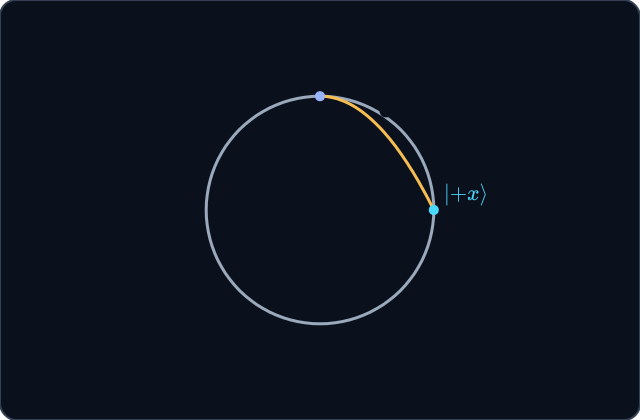
The Bloch vector of a decaying qubit started in , with the ground state at the top: and , so it moves along through the inside of the ball — mixed on the way — to the pure ground state.
The Lindblad equation
For a Markovian environment, with jump operators and :
Properties
- Markovian: the environment relaxes much faster than the system changes, so the future depends only on the present — the hierarchy .
The Lindblad equation from Kraus operators
Over a short step the environment either records nothing or records a jump. The no-jump operator is the identity minus terms of order ; a jump has amplitude of order , so its probability is of order . The requirement that the probabilities add to one fixes the anti-Hermitian part of the no-jump operator. Apply one step of the channel, keep first order in , and divide.
Proof steps
No jump, or jump , over a short step.
The term is exactly what makes the probabilities add to one.
One step of the channel.
Keep the terms of first order in .
Divide by .
Applications
Practice
Two Kinds of Term
The commutator term is the system’s own evolution, as in the von Neumann equation. The other terms are the environment’s: jumps, and the loss of amplitude that goes with not jumping.
Try it
What does the first term of the Lindblad equation, , describe?
Decay
With the jump operator , the excited population falls exponentially at the rate .
Try it
An atom decays with s. What fraction of the excited population remains after 1 μs? Give three decimal places.
Probability Kept
The terms of the Lindblad equation are arranged so that the trace of never changes: the anticommutator removes exactly what the jumps add.
Try it
The Lindblad equation can change the trace of .
Coherence at Half the Rate
Under decay the coherence falls at half the rate of the excited population.
Try it
Under decay with , by what factor is the coherence multiplied? Give three decimal places.
Markovian
The equation assumes an environment that forgets: it relaxes much faster than the system changes, so only the present state matters.
Try it
When is the Lindblad equation a good description?
Try it
Under pure dephasing with μs, what fraction of the coherence remains after 1 μs? Give three decimal places.
Try it
In the derivation, the amplitude of a jump during a short time is of order .
Final checkpoint
Try it
What is the anticommutator ?
Try it
Under decay alone, , a qubit ends up completely mixed.
Try it
Which jump operator describes spontaneous decay from to ?
Completion
Lesson complete
Great work! You now know how to:
- derive the Lindblad equation from short-time Kraus operators
- solve it for decay and for pure dephasing
- say when it applies