Intuition
Every channel can be written with a few operators on the system alone: , with . For a system meeting an environment that starts in , they are , one for each state the environment could be found in afterwards. Kraus proved the converse: every channel has this form, with at most operators, and sets related by a unitary describe the same channel. Two examples carry most of the physics of a qubit. Phase damping shrinks the coherences and leaves the populations alone. Amplitude damping lets the excited state fall to the ground state with probability , as spontaneous decay does, and drives every state towards the ground state.
A pinball enters a machine, bounces off pins it cannot see, and leaves by one of several exits. The Kraus operators are the exits, each with its own effect on the ball; averaging over the exits gives the channel.
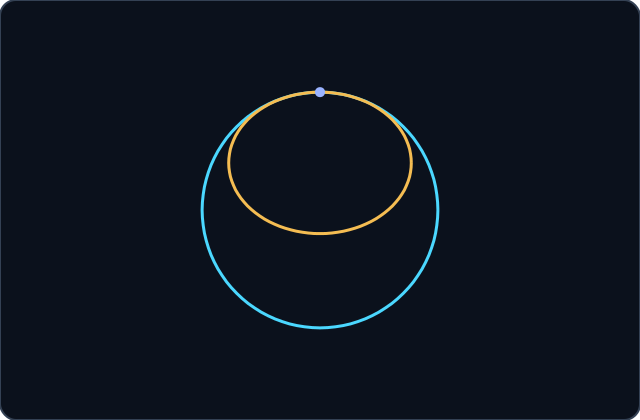
A cut through the Bloch ball under amplitude damping with , the ground state at the top. The sphere is carried onto an ellipsoid pulled up towards the ground state: lengths shrink by , sideways ones by , and the centre moves up by .
Kraus operators
Every channel can be written as
Properties
- Kraus’s theorem: every channel on a -dimensional system has this form, with at most operators; sets related by a unitary mixing give the same channel. Stated here without proof.
Kraus operators from an environment
Evolve the system with the environment, which starts in , and take the partial trace in a basis of the environment. Each term of the trace sandwiches the system’s state between the operator and its adjoint, and the unitarity of makes these operators add up, as , to the identity.
Proof steps
The whole evolves; the environment starts in .
The partial trace in a basis of the environment.
Each is an operator on the system.
Completeness in the environment, then .
Applications
Practice
Amplitude Damping
Amplitude damping lets the excited state fall to the ground state with probability . The jump is the Kraus operator .
Try it
Amplitude damping with acts on the excited state . What is afterwards?
Keeping the Trace
Probabilities add to one exactly when the Kraus operators satisfy .
Try it
Which condition on the Kraus operators keeps the trace of ?
Phase Damping
Phase damping records whether the qubit is 0 or 1 and does nothing else: the populations stay and the coherences shrink by .
Try it
Phase damping changes the populations and .
Coherence Under Amplitude Damping
Amplitude damping multiplies the coherence by , since only keeps it, with on one side and on the other.
Try it
Amplitude damping with multiplies the coherence by what factor?
Try it
At most how many Kraus operators does a channel on a qubit need?
Try it
Phase damping with is applied five times. By what factor are the coherences multiplied? Give three decimal places.
Try it
Two different sets of Kraus operators can describe the same channel.
Final checkpoint
Try it
Where does amplitude damping, applied again and again, take any state of a qubit?
Try it
Each Kraus operator of a channel must be unitary.
Try it
In , what does the label stand for?
Completion
Lesson complete
Great work! You now know how to:
- derive the Kraus form of a channel from a system and its environment
- apply phase damping and amplitude damping
- check that a set of Kraus operators keeps the trace