Intuition
Decoherence is what happens to a superposition when the environment keeps a record. Let a qubit in meet an environment that ends in if the qubit is 0 and in if it is 1. The populations stay and , but the coherence is multiplied by the overlap . Once the environment tells 0 from 1, the overlap is near zero and the qubit behaves as a mixture: interference is gone. A large environment takes many small records, their overlaps multiply, and the coherence falls fast and never comes back. A macroscopic body has astronomically many such witnesses, which is why its superpositions are never seen. Decoherence does not, by itself, say which outcome occurs; that part of the measurement problem it leaves open.
A whisper in an empty room can still be taken back; in a crowded room each listener catches a fragment, and the fragments together can never be recalled. Decoherence spreads a which-way record among many listeners.
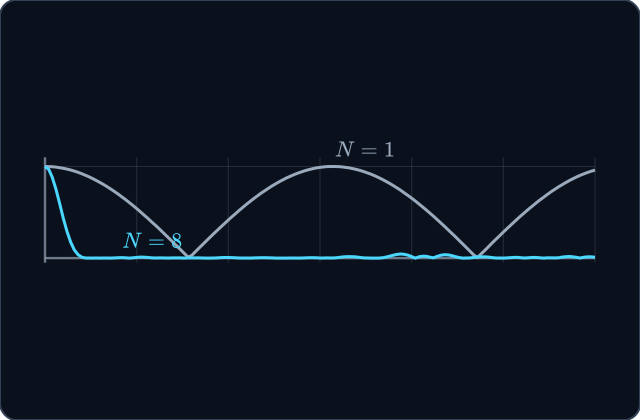
The size of a qubit’s coherence against time, when each of partners in the environment takes a record at its own rate. With the overlap comes back to 1; with the product of the overlaps falls and stays near zero.
Decoherence
An interaction that records the qubit’s state in the environment without changing it:
Properties
- The populations and are unchanged: the environment records which state, without moving it.
- : a coherence can only shrink, and it vanishes when the records are orthogonal.
Coherence times overlap
Let the interaction copy the qubit’s value into the environment. By linearity the superposition becomes an entangled state; tracing out the environment leaves the diagonal alone and multiplies each off-diagonal term by the overlap of the two records.
Proof steps
A product of the qubit and its environment.
The environment records the value without changing it.
Linearity.
Trace out the environment; h.c. is the Hermitian conjugate of the term before it.
Only the coherence changes, by the overlap of the records.
Applications
Practice
Coherence Times Overlap
When the environment records the state of a qubit, its coherence is multiplied by the overlap of the two records.
Try it
A qubit in meets an environment whose records have . What is afterwards?
Populations Stay
An environment that only records the value of a qubit does not change the probabilities of 0 and 1.
Try it
Decoherence of this kind changes the populations and .
No More Interference
Interference between and lives in the coherence. When it vanishes, the qubit behaves as a mixture.
Try it
Why does a qubit whose value has been fully recorded by the environment no longer interfere?
Many Small Records
Each part of the environment multiplies the coherence by its own overlap. Many overlaps close to 1 still multiply into a small number.
Try it
Each of 10 particles of the environment leaves an overlap of 0.9. By what factor is the coherence multiplied? Give three decimal places.
Pointer States
The states of a system that its environment leaves undisturbed stay pure while every superposition of them decoheres. They are called pointer states.
Try it
Which states of a dust grain survive decoherence by scattered light?
Try it
Decoherence alone decides which outcome a measurement gives.
Try it
A coherence falls as . What fraction of it remains after ? Give three decimal places.
Final checkpoint
Try it
With one partner in the environment the coherence comes back; with many, it does not. Why?
Try it
When the two records of the environment are orthogonal, the qubit alone is indistinguishable from a mixture of and .
Try it
Why is a cat never seen in a superposition of alive and dead?
Completion
Lesson complete
Great work! You now know how to:
- derive how an environment’s record shrinks a coherence
- say why many small records make the loss permanent
- say what decoherence explains and what it does not