Intuition
Experiments sum up the noise on a qubit with two times. , the relaxation time, is how long the excited state takes to decay: the populations relax as . , the dephasing time, is how long a superposition keeps its phase: the coherences fade as . Decay alone already kills coherence at half its own rate, so extra dephasing only adds: , and can never exceed . Superconducting qubits reach a few hundred microseconds; trapped ions and nuclear spins keep their phase for seconds or more. A Ramsey measurement reads directly; a spin echo, which undoes slow drifts of the qubit’s frequency, recovers part of what a Ramsey measurement loses.
A spinning top eventually falls over; that is . A crowd of tops set spinning together loses its common rhythm long before any falls, because each spins at a slightly different rate; that is .
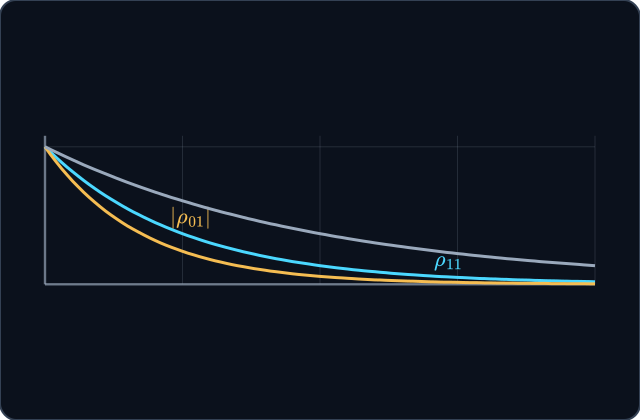
A qubit with and , time in units of , each curve drawn relative to its value at the start: the excited population falls as , the coherence as . The dashed curve, , is the slowest a coherence can fall; extra dephasing makes it faster.
Relaxation and dephasing times
For a qubit with relaxation time , pure-dephasing time and dephasing time :
Properties
- is set by energy exchanged with the environment; by fluctuations of the qubit’s frequency that exchange no energy.
- , with equality when there is no pure dephasing.
T_{2} can never exceed 2T_{1}
Decay, the jump , shrinks a coherence at half its rate; pure dephasing, , shrinks it at the rate . Both act at once, so their factors multiply and their rates add. Since the pure-dephasing rate cannot be negative, the total rate is at least .
Proof steps
The jump shrinks coherences at half the decay rate.
The jump shrinks them at the rate .
Both act together; the factors multiply.
The rates add, and .
With equality only without pure dephasing.
Applications
Practice
Relaxation
The excited population falls exponentially, by a factor in each relaxation time .
Try it
A qubit has μs. What fraction of the excited population remains after 60 μs? Give three decimal places.
Dephasing
is how long a superposition keeps its phase: the coherence of the density matrix fades by a factor in each .
Try it
What does measure?
Never Beyond 2T_{1}
Decay alone already shrinks coherences at half its rate, and anything else only adds. So is at most .
Try it
A qubit can have .
Rates Add
The rates of the two causes of dephasing add up.
Try it
μs and μs. What is , in μs? Give one decimal place.
Try it
With no pure dephasing, what is ?
Try it
A qubit has μs and each gate takes 50 ns. About how many gates fit into one ?
Try it
A spin echo can undo dephasing caused by slow, steady drifts of the qubit’s frequency.
Final checkpoint
Try it
What sets ?
Try it
Pure dephasing shortens .
Try it
Two qubits have μs; one has μs and the other μs. Which has more pure dephasing?
Completion
Lesson complete
Great work! You now know how to:
- describe a qubit’s noise by and
- prove that never exceeds