Intuition
The expectation value says where the results of many measurements settle; the spread says how far they scatter. It is measured by the standard deviation, which quantum mechanics calls the uncertainty of the observable in that state. It is zero exactly when every measurement gives the same result, which happens exactly when the state is an eigenvector.
Two archers can have the same average position on the target, one with every arrow in the gold and one scattered over the whole board. The average does not tell them apart; the spread does.
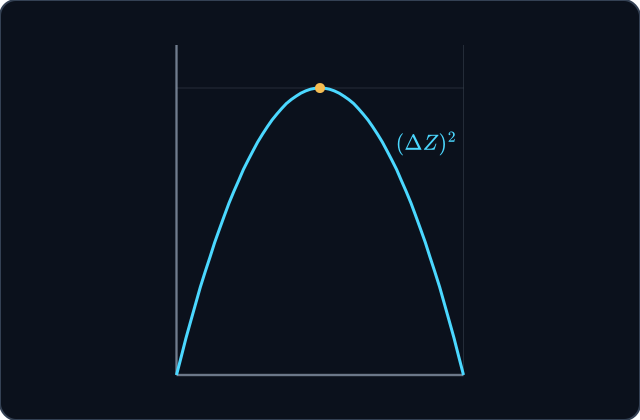
The spread of in a state , against the probability of the result : . It vanishes only at and , the two eigenvectors, and is largest for an even split.
Variance and uncertainty
The variance of an observable in a state is the expectation value of the squared deviation from the mean. Its square root, , is the standard deviation, also called the uncertainty of in the state. Expanding the square gives the form used in calculations.
Properties
- The variance is never negative, so always.
Zero spread means an eigenvector
Because is Hermitian, the variance is the squared length of the vector . A vector has length zero only if it is the zero vector, which says precisely that is an eigenvector with eigenvalue .
Proof steps
The deviation operator is Hermitian, since is a real number.
Move one factor of across the bracket.
Only the zero vector has length zero.
That is the eigenvalue equation, with the mean as the eigenvalue.
Applications
Practice
Mean of the Square Minus Square of the Mean
The variance is the average of the squared results minus the square of the average result. For an observable whose eigenvalues are , the squared result is always one.
Try it
What is in the state ?
An Uneven Split
For an observable with eigenvalues the variance is one minus the square of the mean. If the two results have probabilities and , that is .
Try it
What is in the state ? Give two decimal places.
Sharp Values
An uncertainty of zero means every measurement gives the same result, which happens exactly in an eigenvector of the observable.
Try it
If in a state, then that state is an eigenvector of .
Shifting and Scaling
Adding a constant to every result moves the average but not the scatter. Multiplying every result by multiplies the scatter by the size of .
Try it
If in some state, what is in that state?
Try it
An observable takes the values 0 and 2 with probabilities 0.5 each. What is its variance?
Try it
For every observable and every state, .
Try it
The state has . What is in the same state, with ?
Final checkpoint
Try it
For an observable with eigenvalues and , what is the largest possible over all states?
Try it
Doubling an observable doubles its variance.
Try it
In which state is , for ?
Completion
Lesson complete
Great work! You now know how to:
- compute a variance and an uncertainty from a state
- prove that zero spread happens exactly in an eigenvector
- shift and scale an observable and follow its spread