Intuition
Measure a quantity and then measure it again straight away: the second result repeats the first, because the first measurement left the system in the eigenvector it found. Measure something incompatible in between and the memory is wiped: the first quantity is random again. Three polarisers show it vividly — horizontal and vertical together block everything, but a diagonal one slipped between them lets light through.
Asking someone the same question twice gets the same answer. Asking an unrelated question in between should not matter — but in quantum mechanics it can, and the second answer to the first question becomes a coin toss.
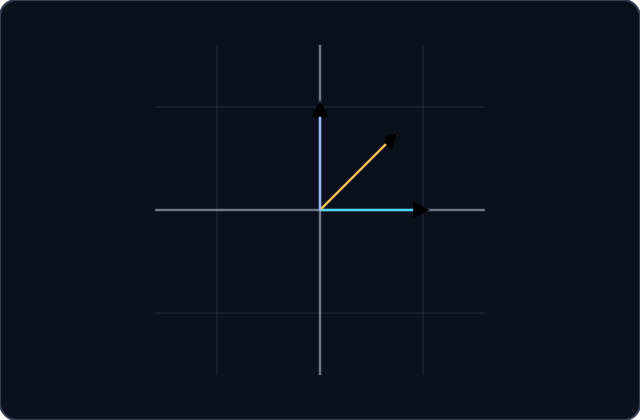
The axes of three polarisers in a row. Horizontal followed by vertical passes nothing. With the diagonal one between them, a photon that passed the first passes the second with probability , is left diagonal, and passes the third with probability : a quarter get through.
Sequences of measurements
Because a measurement leaves the system in the eigenvector of the result found, the probability of a sequence of results is a product: the probability of the first result, times the probability of the second given the state the first one left, and so on.
Consequences
- Repeating a measurement immediately gives the same result, since .
- An incompatible measurement in between erases the first result: from , measuring leaves , and is then with probability each.
Probabilities of sequences multiply
The first measurement gives with the Born probability and leaves the state . The second measurement is then made on , so the Born rule applies again with in place of . The chance of both is the product, as for any two stages in succession.
Proof steps
The Born rule for the first measurement.
The result leaves the eigenvector behind.
The Born rule for the second measurement, made on .
The probability of both is the first times the second given the first.
Applications
Practice
Multiply Along the Sequence
Each measurement leaves the system in the state it found, so the probability of a sequence of results is the product of one Born probability per step.
Try it
A horizontally polarised photon meets a polariser at 45 degrees and then a vertical polariser. What is the probability that it passes both?
Asking Twice
A measurement leaves the eigenvector of its result, so repeating it at once gives the same result with certainty.
Try it
Measuring an observable twice in immediate succession can give two different results.
An Incompatible Measurement Erases
Measuring a quantity whose eigenvectors are not those of the first leaves one of its own eigenvectors. Measured again, the first quantity is uncertain once more.
Try it
A qubit in has measured, giving ; then is measured; then again. What is the probability that the last result is ?
Unpolarised Light
Unpolarised light is a random mixture of polarisations. An ideal polariser passes half of it, and what emerges is polarised along the polariser’s axis.
Try it
Unpolarised light meets three polarisers with axes at 0, 45 and 90 degrees in that order. What fraction of the light emerges?
Try it
A qubit starts in . Which sequence certainly ends with the result for its final measurement?
Try it
Two polarisers with perpendicular axes, one after the other, pass no light at all.
Try it
A horizontally polarised photon meets a polariser at 60 degrees, then a horizontal polariser. What is the probability that it passes both?
Final checkpoint
Try it
Why can very frequent measurement hold a quantum system in its initial state?
Try it
A state gives the result with probability , and from the next measurement gives with probability . What is the probability of followed by ?
Try it
For two observables that do not commute, the probabilities of a sequence of results can depend on which is measured first.
Completion
Lesson complete
Great work! You now know how to:
- multiply Born probabilities along a sequence of measurements
- explain why repeating a measurement gives the same result
- explain how an incompatible measurement erases an earlier one