Intuition
Can a state be sharp for two observables at once? If they commute, yes. If they do not, their spreads are tied together: the product of the two uncertainties can be no smaller than half the size of the average of their commutator. It follows from nothing more than the Cauchy–Schwarz inequality of the first chapter, and for position and momentum it becomes Heisenberg’s famous limit.
A note played for a very short time has no definite pitch: the shorter the burst, the wider the spread of frequencies in it. Two quantities that do not commute are like duration and pitch — squeezing one widens the other.
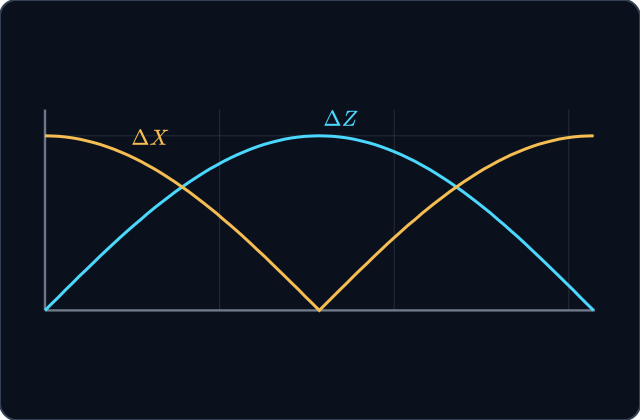
For the real states , the spreads of and against . Where one is zero the other is 1: the state cannot be sharp for both, because and do not commute.
The Robertson uncertainty relation
For any two observables and any state, the product of their uncertainties is bounded below by half the modulus of the expectation value of their commutator. The bound depends on the state, and it is zero when the observables commute.
What it says and what it does not
- For and , with , so .
The uncertainty relation
Build two vectors from the state: the deviations of and of acting on it. Their lengths are the two uncertainties. Cauchy–Schwarz bounds their overlap by the product of the lengths, and the imaginary part of the overlap turns out to be half the average commutator.
Proof steps
Two deviation vectors; as in the last lesson, their lengths are and .
The Cauchy–Schwarz inequality for and .
The modulus squared of a number is at least the square of its imaginary part, and .
Multiplying out, the constant shifts cancel between the two orders and only the commutator survives.
Put the pieces together and take square roots.
Applications
Practice
The Bound Uses the Commutator
The product of two uncertainties is at least half the size of the average commutator. For and the commutator is .
Try it
In a state with , where , what is the smallest can be?
Commuting Observables
When two observables commute, the right-hand side of the relation is zero, and nothing stops a state from being sharp for both.
Try it
If , the uncertainty relation allows a state with .
A Property of the State
The uncertainties in the relation are spreads of results over many identically prepared systems. The relation says no preparation makes both spreads small; it is not about a measurement disturbing a system.
Try it
What does the uncertainty relation for two non-commuting observables say?
Checking the Bound
To test the relation in a particular state, compute each uncertainty and the average commutator, and compare.
Try it
In the state , what is ?
Try it
The uncertainty relation is a statement about the imprecision of measuring instruments, which better technology could remove.
Try it
A particle's position is known to within nm. Using , what is the smallest possible , in units of per nanometre?
Try it
For and the bound is . In which state is the bound zero?
Final checkpoint
Try it
For observables with and , no state has .
Try it
In some state and . What is the smallest can be?
Try it
Which inequality does the proof of the uncertainty relation rest on?
Completion
Lesson complete
Great work! You now know how to:
- state the uncertainty relation and prove it from Cauchy–Schwarz
- evaluate the bound for a given pair of observables and state
- say what the relation is about and what it is not