Intuition
Quantum mechanics does not say what a single measurement will give. It says with what probability each result will appear: expand the state in the eigenvectors of the observable, and the probability of each eigenvalue is the modulus squared of its coefficient. And the measurement leaves its mark: right afterwards, the system is in the eigenvector that was found.
A state is a set of odds, not a hidden answer. Measuring is rolling the die those odds describe — and once it has landed, the die shows one face and the odds are gone.
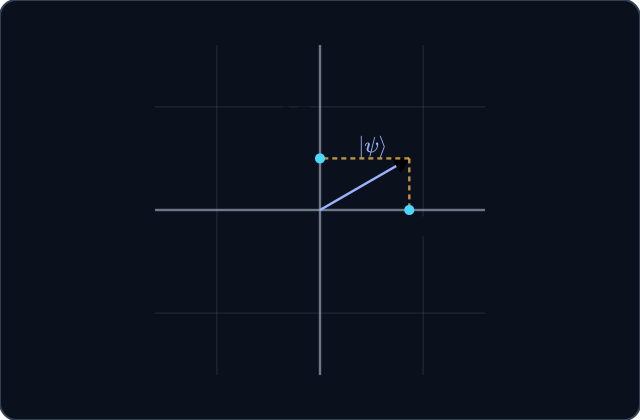
A photon polarised at above the horizontal, . Its components along the two outcomes of a horizontal–vertical measurement are 0.866 and 0.5, so the probabilities are and .
The Born rule and the state after
Measuring an observable with non-degenerate eigenvalues and normalised eigenvectors on a system in the normalised state gives the result with probability equal to the modulus squared of the overlap. Immediately after a measurement that gave , the system is in the state .
Reading the postulates
- The probabilities are those of the first chapter's expansion: in the eigenbasis of , .
The probabilities add up to one
The eigenvectors of a Hermitian operator form an orthonormal basis, so the completeness relation holds for them. Inserting it into the squared norm of the normalised state turns that norm, which is 1, into the sum of the probabilities.
Proof steps
The eigenvectors of the observable form an orthonormal basis: the spectral theorem.
The state is normalised.
Insert the completeness relation.
Each term is an overlap times its conjugate: a probability.
Applications
Practice
Modulus Squared of the Overlap
The probability of a result is the modulus squared of the overlap between the state and the eigenvector of that result.
Try it
A photon is in the state and its polarisation is measured as horizontal or vertical. What is the probability of the result horizontal?
The State Afterwards
Right after a measurement that gave the result , the system is in the eigenvector of . The rest of the superposition is gone.
Try it
A photon in the state is measured and found horizontal. What is its state immediately afterwards?
Probabilities, Not Predictions
The Born rule says how often each result appears over many identically prepared systems. For a single system it does not say which result will appear.
Try it
Knowing the state exactly, quantum mechanics predicts which result a single measurement will give.
Several Outcomes
With more than two eigenvalues the rule is the same: each outcome gets the modulus squared of its own coefficient, and they add to one.
Try it
In the eigenbasis of an observable with eigenvalues 1, 2 and 3, a state has coefficients , and , with real and positive. What is the probability of the result 3?
Try it
A thousand photons, each in the state , meet a horizontal polariser. About how many pass?
Try it
The change of state caused by a measurement can be undone by a suitable unitary operator.
Try it
A photon in has its polarisation measured along the diagonal basis , . What is the probability of the result antidiagonal?
Final checkpoint
Try it
The state is measured in the eigenbasis of . What is the probability of ?
Try it
An observable has three eigenvalues. For some state the probabilities of the first two are 0.2 and 0.45. What is the probability of the third?
Try it
If a measurement of gives , then measuring again immediately gives with certainty.
Completion
Lesson complete
Great work! You now know how to:
- compute the probability of each result with the Born rule
- say what state a measurement leaves behind
- prove that the probabilities of all results add to one
- read the rule as a prediction of frequencies