Intuition
In 1935 Einstein, Podolsky and Rosen argued that quantum mechanics is incomplete. In Bohm’s version a pair in the singlet flies apart. Measuring along predicts ’s result with certainty, without touching ; measuring along would have predicted ’s result with certainty instead. If whatever can be predicted with certainty without disturbing a system is an element of reality, and if ’s choice cannot reach far away, then must carry definite values of both and — and quantum mechanics has no state with both. So, they concluded, the theory is incomplete, and further variables should complete it. For thirty years this seemed a matter of taste. Bell turned it into an experiment.
Two sealed envelopes with a card each are posted to two cities: opening one tells you the other card at once, and nobody thinks the opening sent anything. EPR argued that entangled pairs must be like that, every answer written in advance. The next lessons show the envelopes cannot hold answers that agree with quantum mechanics.
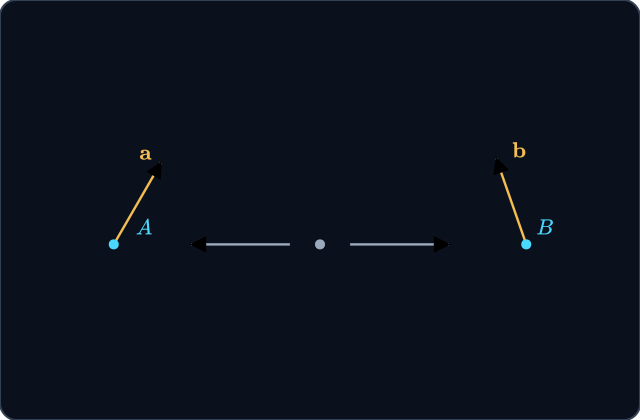
Bohm’s form of the EPR experiment: a source sends the two spins of a singlet to and , where each is measured along an axis chosen there, and .
The EPR argument
The singlet has the same form along every axis :
The two assumptions and the conclusion
- Reality: if a value can be predicted with certainty without disturbing the system, it is an element of reality, there before any measurement.
- Locality: what is chosen or done at cannot change what exists at far away.
- With the singlet, a measurement at along any axis predicts along that axis with certainty, so would carry values of and at once.
The singlet is anticorrelated along every axis
Check that each component of the total spin annihilates the singlet. Then the spin of along any axis acts on the singlet as minus the spin of along that axis, and the product of the two acts as : the results are opposite every time.
Proof steps
For : becomes ; and are alike.
Combine the three components with the weights of .
Move ’s factor onto , where .
The product of the two results is every time: always opposite.
Applications
Practice
Two Assumptions
EPR assumed reality — a value that can be predicted with certainty, without disturbing the system, exists before it is measured — and locality — a choice at cannot change what exists at .
Try it
On which two assumptions does the EPR argument rest?
Prediction Without Touching
With the singlet, a result at along any axis fixes the result at along the same axis, without anything done to .
Try it
With the singlet, measuring spin along lets one predict spin ’s result along with certainty.
Incomplete
Since quantum mechanics gives no state with definite values of non-commuting spin components, EPR concluded that it leaves something out.
Try it
What did Einstein, Podolsky and Rosen conclude?
Always Opposite
Each side records or . For the singlet along a common axis the two records are always opposite, so their product is always .
Try it
For the singlet measured along a common axis, what is the mean of the product of the two results, each ?
Try it
Why did EPR hold that ’s value existed before measured?
Try it
In the position form of the argument the pair has . With μm and found at μm, where is , in μm?
Try it
The EPR argument found a prediction of quantum mechanics that disagrees with experiment.
Final checkpoint
Try it
In the same state the momenta satisfy . If is found to be 3, in some units, what is ?
Try it
Quantum mechanics has states of a spin in which and both have definite values.
Try it
What turned the EPR question from a matter of interpretation into one of experiment?
Completion
Lesson complete
Great work! You now know how to:
- state the EPR argument and its two assumptions
- prove that the singlet is anticorrelated along every axis
- say what EPR concluded and what they did not dispute