Intuition
If measuring at once changes what can be predicted about , can send a message? No. Whatever does — measure along any axis, turn her spin, or nothing — ’s reduced state is unchanged, and everything can observe depends only on it. ’s choice changes how ’s ensemble is split, not the ensemble: after measures along , is or , half the time each; after measures along , he is or , half the time each; either way he holds . The correlations show only when the two lists of results are brought together by ordinary means. A second limit backs this up: an unknown quantum state cannot be copied. If it could, would copy his spin many times and learn which ensemble he held.
Matching sealed envelopes cannot carry a message: opening mine tells me about yours but changes nothing you see. Entanglement is stronger than envelopes, and just as silent.
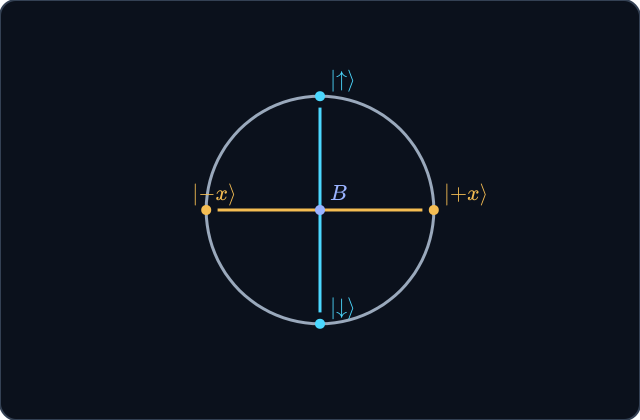
Spin of a singlet, on a cut through its Bloch sphere. If measures along , is left at or ; if along , at or — half the time each. Averaged over ’s unknown result, sits at the centre either way, so nothing measures reveals ’s choice.
No signalling and no cloning
Whatever is done to alone — a unitary , or a measurement with projectors whose result is not sent — leaves with
Properties
- The identity holds because and the trace over lets move around the cycle; for a unitary, does the same.
No cloning
A unitary keeps inner products. Compute the inner product of the two inputs, which is because the blank is normalised, and of the two outputs, which is its square. A number equal to its own square is 0 or 1: the two states are orthogonal or the same.
Proof steps
Suppose one device copies two states onto a blank .
and .
The same inner product, from the outputs.
Equate the two.
So no device copies every state.
Applications
Practice
B Sees Nothing
Averaged over ’s results, which does not know, ’s reduced state is the same whatever did. So are all of ’s statistics.
Try it
measures her spin of a singlet along instead of . What changes in ’s statistics, before any comparison of results?
No Signalling
What observes depends only on ’s reduced state, and nothing done at alone changes it.
Try it
By choosing her measurement axis, can change the probabilities observes.
Averaged Over A
After ’s measurement is in one state or another, but does not know which. His description averages over ’s results.
Try it
measures along and does not tell the result. What is the probability that finds up along ?
No Cloning
A unitary keeps inner products, and a perfect copier would square them. So one device can copy only states that are equal or orthogonal.
Try it
Which pairs of states can one device copy perfectly?
Try it
A device copies and perfectly. Their overlap is real and not zero. What must it be?
Try it
The correlations of the singlet can be seen only after the results from both sides are brought together.
Try it
measures along and gets . What is then the probability that finds up along ?
Final checkpoint
Try it
Why can not signal to by choosing what to measure?
Try it
The no-cloning theorem forbids any device from copying .
Try it
Why does no cloning make quantum key distribution secure?
Completion
Lesson complete
Great work! You now know how to:
- prove that nothing done to one part changes the other’s reduced state
- prove that unknown states cannot be copied
- explain why entanglement carries no message