Intuition
Bell asked what any local theory with pre-set answers must obey. Suppose each pair carries instructions that fix the results for every setting, ’s depending only on ’s setting and ’s only on ’s. With two settings on each side, , and , , the combination is always : one of the brackets is 0 and the other . Its average, the CHSH combination of four correlations, therefore lies between and 2. Quantum mechanics breaks the bound: for the singlet at the right angles . Experiments since the 1970s, and loophole-free ones since 2015, side with quantum mechanics: no local theory of pre-set answers describes nature.
If twins answered every question from a shared list written before they parted, their agreement over four pairs of questions would be capped by simple counting. Entangled pairs beat the cap, so they cannot be twins with lists.
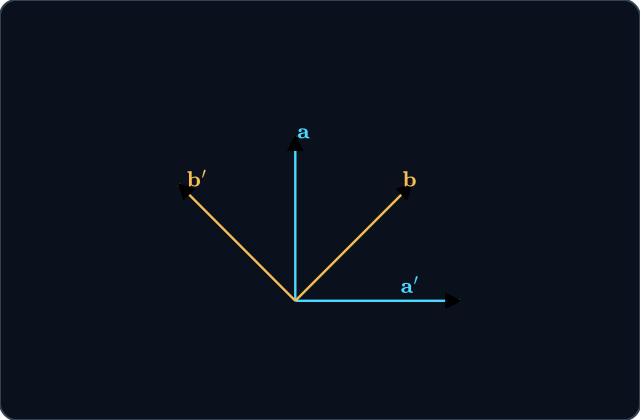
The standard settings: for one side, for the other, turned from them. Three of the four pairs are apart and are apart, which gives the singlet .
The CHSH inequality
For settings at and at :
Properties
- Local pre-set answers: , with drawn from a distribution that does not depend on the settings.
- For the singlet, ; at the settings in the figure .
The CHSH inequality
For each value of the hidden variables the four answers are fixed numbers . Then and cannot both be nonzero: one is 0 and the other . So the combination is for every , and its average, which is , cannot exceed 2 in size.
Proof steps
Pre-set answers for every setting, each depending only on its own side.
Two numbers are either equal or opposite.
One bracket vanishes and the other is , multiplied by .
Each correlation is the average of a product; locality lets them share one .
The average of numbers of size 2 is at most 2 in size.
Applications
Practice
The Quantum Value
With and three of the four angles at and the fourth at , the four correlations add up, in size, to .
Try it
With and the four angles and (the last for ), what is ? Give three decimal places.
The Local Bound
Pre-set local answers keep the CHSH combination between and 2, whatever the settings.
Try it
What does local realism allow for ?
Plus or Minus Two
With answers , one of and is zero and the other is , so the combination is always .
Try it
For pre-set answers , the combination can be 0.
Breaking It
Only entangled states can break a Bell inequality; the singlet at the settings of the figure breaks it by the most any quantum state can.
Try it
Which state can break the CHSH inequality?
Try it
The straight-line local model, , is used at the same four angles and . What is ?
Try it
Experiments have measured above 2, as quantum mechanics predicts.
Try it
What does a measured violation of Bell’s inequality rule out?
Final checkpoint
Try it
An experiment measures , , and . What is ?
Try it
Breaking Bell’s inequality lets send a message to faster than light.
Try it
Why must each side choose its setting freely, after the pair has left the source?
Completion
Lesson complete
Great work! You now know how to:
- derive the CHSH inequality from pre-set local answers
- show that the singlet breaks it, reaching
- say what the experiments rule out and what they do not